The revelation of John
In the period between Plato’s work in Greece and the writing of Nicomachus’ handbook, Jewish authors composed numerous apocalyptic writings that drew on the books of the Old Testament prophets on the one hand and the wisdom literature on the other – they served as consolation and motivation in a time of intense persecution. One of these “revelations” was written in 167 – 164 BC by the Syrian king Antiochus IV Epiphanes and found its way into the book of Daniel in the Bible. A second is the Revelation of John, which concludes the Bible. For a long time it was believed that the author was identical to the apostle John, but today it is assumed that this is not the case and that we only know about him what he himself reveals to us in the text. The Revelation of John was probably written during the reign of the Roman Emperor Domitian, which lasted from 81 to 96 AD.
It is reasonable to assume that a vision of the end of times was inspired by great pictorial metaphysical designs and doomsday scenarios and also – true to the clandestine activities of persecuted minorities – by coded symbolism that was only accessible to the initiated. It is therefore not surprising that one encounters numerous motifs in the text that seem to originate from the metaphorical world creation and doomsday myths of earlier times.
The clearest indication of this is the remarkable numerical symbolism of John’s text:
4,4 And around the throne were twenty-four thrones, and on the thrones sat twenty-four elders clothed in white robes and with golden crowns on their heads.
4,5 From the throne came lightning, voices and thunder. And seven flaming torches were burning before the throne; these are the seven spirits of God.
4,6 And before the throne was something like a sea of glass, like crystal.
And in the center, around the throne, were four living creatures full of eyes, in front and behind.
4,7 The first creature looked like a lion, the second like a bull, the third like a man, the fourth like a flying eagle.
4,8 And each of the four living creatures had six wings, full of eyes outside and inside.
7,1 Then I saw four angels standing at the four corners of the earth. They held the four winds of the earth, so that the wind did not blow on the land or on the sea or against any tree. 2 Then I saw another angel ascending from the east, having the seal of the living God, and calling with a loud voice to the four angels who had been given authority to harm the land and the sea: 3 Do not harm the land, the sea or the trees until we have pressed the seal on the foreheads of the servants of our God.
4 And I learned the number of those who were marked with the seal. They were a hundred and forty-four thousand from all the tribes of the sons of Israel who bore the seal:
5 Of the tribe of Judah twelve thousand bore the seal,/ Of the tribe of Reuben twelve thousand,/ Of the tribe of Gad twelve thousand,
6 Of the tribe of Asher twelve thousand; of the tribe of Naphtali twelve thousand; of the tribe of Manasseh twelve thousand,
7 of the tribe of Simeon twelve thousand, of the tribe of Levi twelve thousand, of the tribe of Issachar twelve thousand,
8 twelve thousand of the tribe of Zebulun, twelve thousand of the tribe of Joseph, and twelve thousand of the tribe of Benjamin bore the seal.
9 Then I saw a great multitude from every nation, tribe, people and language; no one could count them.
The text is divided into several parts: In an introduction, John addresses seven Christian communities that are being persecuted by the autocratic Emperor Domitian. Geographically speaking, the seven communities form a circle. The actual vision begins with a description of the end-time heaven, followed by a description of Satan’s battle against the people of God. The culmination is found in the outline of the great judgment on people, the earth and Satan.
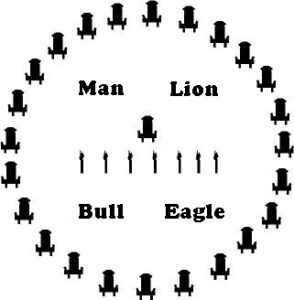
At the center of the vision of heaven is the throne of God, around which the twenty-four elders sit in a circle. In addition, seven torches are blazing, symbolizing the seven spirits of God. Also seated around the throne are four living creatures: a lion, a bull, a man and an eagle. The arrangement can be graphically depicted somewhat suggestively:
A «lamb» with seven horns and seven eyes receives a scroll sealed with seven seals from the right hand of «him who sits on the throne», whereupon the four living creatures and twenty-four elders – equipped with harps, golden bowls and incense – fall down and sing a new song. Around the throne, many angels also begin to sing, namely «ten thousand times ten thousand and a thousand times a thousand».
The same scenario is then played out three times, once using the seven seals, once with seven trumpets as announcers and once in seven images, all of which begin with «and I saw». These images also have a concentric structure. They depict the end times, in which catastrophes befall humanity, the good are separated from the bad and the «new Jerusalem comes down».
The report is characterized by symbolically placed, precise quantities. In addition to the all-dominant seven, the following also play a role:
- 2 (witnesses, olive trees, candlesticks, prophets, animals, horns)
- 3 (angels, catastrophes, spirits, parts of the city, gates)
- Third (earth, trees, of the sea, sea creatures, ships, rivers, of the moon and stars, brightness, day, night, mankind/people, stars)
- Three and a half (days, years)
- 4 (mighty figures, angels, winds, horns, ends)
- Quarter (of the earth)
- 5 (months, kings)
- 6 (wings)
- 7 (churches, spirits, golden candlesticks, stars, spirits of God, torches, seals, horns, eyes, angels, trumpets, thunder, heads, disasters, golden bowls, hills, kings)
- 8 (kings)
- 10 (days, horns, kings)
- Tenth (of the city)
- 12 (stars, gates, angels, tribes, foundation stones, apostles, precious stones, pearls)
- 24 (thrones, elders)
- 42 (months)
- 144 (cubits)
- 666 (number of the beast)
- 1000 (years)
- 12,000 (distance)
- 1260 (days)
- 1600 (mass of path)
- 7000 (people)
- 12 000 (tribesmen)
- 144 000 (tribesmen)
- Thousands and thousands (angels, actually 20,000 myriads, i.e. 200 million)
- Millions and millions (mounted troops)
This list exhausts the numerical occurrences in Revelation.
There are two important remarks to be made here: Firstly, the Hebrew script has no special characters for numbers and no vowels. Instead, each letter is assigned a numerical value. Therefore, each name can also be assigned a number, which of course opens the door to mystical number speculation. For example, the number 666 – the ominous number of the devil – was assigned to the name “Qesar Nero”, also in the variant “Nero redivivus”. However, in an article on the Apocalypse published in 1974, Heinrich Kraft points out that it is possible to associate almost any Roman emperor with the number using all kinds of arithmetic.
The theologian Ernst Lohmeyer offers an interesting alternative interpretation in a commentary published in 1926. He points out that 666 is the sum of all numbers from 1 to 36 and 36 in turn is the sum of all numbers from 1 to 8, from which he concludes that it could refer to Satan himself in the form of the beast mentioned in the Apocalypse – as the eighth, which exceeds the sacred number seven.
Secondly, the numbers three and a half, 42 and 1260 belong together thematically. The latter are also multiples of the former (1260 days = 42 months of 30 days each in the lunar cycle). Observations such as the fact that the three and a half occurs exactly seven times, as does the name “Christ”, suggest that the text could be even more subtly composed than it appears. “Jesus” appears exactly fourteen times, and other descriptions of Christ also follow the number seven. In addition, a symmetrical, seven-part structure can be found throughout the text.
The figure of a pregnant woman with the moon under her feet and wearing a wreath of twelve stars is also remarkable. Most theologians agree that pagan motifs linked to astral mythology are being taken up here. Echoes of astrological motifs can also be found in the image of the New Jerusalem with its twelve gates and four cardinal points. According to most commentators, the gemstones associated with it also refer to the zodiac. However, there also seem to be echoes of the Atlantis myth.
Seen in this light, the account of Revelation has striking similarities with the mandalas of the Rigveda and the Platonic model of the ideal city. This has not escaped McClain’s notice either. First of all, he quotes “Peake’s Commentary on the Bible”[5], which notes that the Revelation of John contains many motifs that do not come from either Jewish or Christian tradition. The standard English commentary on the Bible traces some motifs back to Persia, Babylon, Egypt and Greece. According to McClain, the foreign elements are a variation of the arithmological world view outlined in the Rigveda. However, some of his interpretations, although interesting, are very speculative. In the number 1260 he sees the distance of the sun in the number of earth radii, as defined in the Ptolemaic world view, and also the composition of the sacred seven, the human five and the divine three. In the prime factorization of 1260, the two appears in the square, as does the three, but not the five and seven, for which there can really be no reason in such an explanation.
McClain’s thoughts on the «number of the beast», which the usual Bible translations give as 666 (or 616), are also highly speculative. Since, as already mentioned, Hebrew has no direct numerical representation, there is a certain amount of room for interpretation. McClain suggests reading 666 as «six times three multiplied by itself», i.e. as 36. This fits in with his interpretation of the number, which assigns the tritone, i.e. the «Diabolus in musica», to 36.
Be that as it may, the number symbolism of the Revelation of John is most probably also inspired by arithmological and musical systems – whether its author was aware of this or not. In the following centuries, and in fact to this day, it forms the free space that Christian thinkers use within the framework of the Bible to pay tribute to the hermetic and astrological view of the world.