Plato and the myth of Atlantis
The world creation theories of the Rigveda find an echo in the works of Plato – as Plato himself mentions via the detour of Egyptian philosophy – especially in the dialogues Timaeus, Critias and the eighth book of the «State».
In this eighth book, Socrates outlines a system of possible forms of government in a dialog with Glaucus. The discussion begins with timocracy, i.e. a form in which civil rights are dependent on income and wealth. At the beginning of this description, like a foreign body, there is a legend about the correct reproduction of the people:
The fruitful and unfruitful times of your generation will not strike the leaders of the state, even if you have educated them to be wise, by reason or feeling. The right moment rushes past them, and so they beget children out of season. For the divinely begotten there is a circulation determined by the completed number, but for the mortally begotten there is that number in which roots and powers multiply as the first number, in three dimensions and four limits; they create equality and inequality, increase and decrease, and they make everything proportional and rational; their basic ratio of three to four, married to the five, gives, thrice multiplied, two harmonies; one is of equal numbers, taken a hundred times as often; the other, square on the one hand, rectangular on the other; in one respect a hundred times the square of the rational diagonals of the five, but each reduced by one, the irrational ones by two, in the other respect a hundred cubes of the three. This, then, is the number, geometrically conceived, the mistress of good and bad births!
The Plato researcher James Adams presented his investigations and interpretations of these figures in 1902. His interpretation is as follows:
| …three to four, married to five… | 3*4*5 = 60 |
| …multiplied three times… | 604 = 12,960,000. To the power of four, because the first number is multiplied three times. |
The same value is obtained by applying the two other methods described by Plato:
| …is of equal multiples (six) of the same number, taken one hundred as many times; the other… | 36*100 = 3600 |
| …squared on the one hand… | 36002 = 12 960 000 |
| … the square of the rational diagonals of the five… | the diagonal of a square with side length 5 would be the square root of 50, i.e. an irrational number. The rational approximation is the square root of 49, i.e. the 7th |
| …but each reduced by one, the irrational ones by two… | 50-2 = 48 |
| one hundred times | 48*100 = 4800 |
| …in the other respect one hundred cubes of the three… | 33*100 = 2700 |
| …rectangular on the other hand… | 2700*4800 = 12 960 000 |
The whole thing results in a strange mixture of Pythagorean number symbolism and Socratic state theory, in which the Indian model still seems to shine through.
Such affinities – and the reference to music – become even more obvious in the tenth book of “The State”, in which the story of Er, the experiences of a fallen warrior in the afterlife, is told. In this myth, which concludes the “State”, Plato provides a powerful description of the spheres and the music they produce:
After four days they came to a place from where they saw a light stretching from above through the whole sky and earth, very straight like a pillar, very much like a rainbow, only more splendid and clearer; after another day they came to it, and there in the middle of the light, they saw the ends of its bands tied to the sky. For this light is the band of heaven, like the straps of the ships of war, and holds the whole swinging vault together. The spindle of necessity is attached to these ends, through which all rotations take place. The shaft and barb are made of steel, but the whorl is made of a mixture of steel and other materials. The whorl has the following characteristics: The outer shape corresponds to that of our whorls; it is clear from his words that it looks as if there is another smaller whorl inside a large and thoroughly hollowed-out whorl, which fits into the other as well as a bucket; and likewise a third, fourth and another four. In total there are eight whorls, which are joined together and from above their edges appear like circles, but around the shaft they form the continuous surface of a single whorl; the shaft is driven through the middle of the eighth whorl. The first and outermost whorl has the widest edge circle, followed in width by the sixth, then the fourth, then the eighth, seventh, fifth, third and finally the second whorl.
The circle of the largest is colored, that of the seventh is the most splendid, the eighth has the color of the seventh, which illuminates it, the circles of the second and fifth are similar to each other, but brighter than those, the third has the whitest color, the fourth is reddish, the sixth is the second brightest. The whole spindle swings in a circular motion, but the inner seven whorls swing slowly in the opposite direction during this rotation. The eighth moves the fastest, the second fastest and at the same time the seventh, the sixth and the fifth, the third fastest moves, as it seemed to them, the fourth, then the third and the second. But the spindle turns in the lap of necessity. At the top of each of the circles is a siren, which rotates and emits a single sound. A single symphony sounds from all eight. The three daughters of Necessity, the Moires, are seated at equal distances around them on a throne, dressed in white and with sacred bandages in their hair: Lachesis, Klotho and Atropos. They sing their song to the song of the sirens, Lachesis about the past, Klotho about the present and Atropos about the future. And Klotho grasps the spindle with her right hand and helps the outer rotation, interrupting it again and again; Atropos does the same with his left hand on the inner rotation. Lachesis, however, intervenes in both from time to time, sometimes here, sometimes there.
The eight celestial spheres are the fixed stars, Saturn, Jupiter, Mars, Mercury, Venus, the sun and the moon. They are mere hemispheres that bear colors corresponding to their planets. This can be seen in a note by the translator Karl Vretska on the passage.
However, the most important passages in Plato’s work for the myth of the harmony of the spheres are the two late dialogues Timaeus and Critias, in which the actual Platonic cosmology is outlined. The Critias also contains the infamous Atlantis myth.
In the Timaeus, as already mentioned, the narrator explains that his story must be traced back to an Egyptian tradition. He then sketches a grandiose picture of the creation of the world, which he sees as a living organism. The «world soul» is created from a primordial substance through arithmetic operations:
Between the indivisible being, which is not subject to change, and the divisible being, which becomes in the bodies, he mixed a third kind of being from both; but as for the nature of the same and that of the different, he also put together a third kind in each of these between the indivisible of them and that which is divided in the bodies. And he took these three and united them all into one form by forcibly harmonizing the nature of the different, which is difficult to unite, with that of the same and blending it with being. And when he had made one out of three, he divided this whole again into as many parts as were appropriate, each of which was a mixture of the Same, the Different and the Being. But he began the following division. First he took one part from the whole, then twice the same, thirdly one and a half times the second, but three times the first, fourthly twice the second, fifthly three times the third, sixthly eight times the first, seventhly twenty-seven times the first; Then he filled in the double and triple distances by cutting off more parts and placing them between them, so that between each distance there were two middle members, one of which exceeded the outer one by the same part of the outer ones, by which it was exceeded by the others, while the other exceeded the one by the same number and was inferior to the other; Since these connections between the first distances created one-and-a-half, four-thirds and nine-eighths distances, he filled all four-thirds distances with the nine-eighths distance by leaving a part of each of them. The numerical ratio of the part left behind from this spacing, however, was two hundred and fifty-six to two hundred and forty-three, and so the mixture from which he had cut off these parts was already completely used. By splitting this entire compound lengthwise in two, joining the center of one to the other in the shape of a chi (X), he bent them together and joined them into one by a circle, each facing itself and the other at the point of (first) meeting, enclosing them all around by the uniform and circular movement in one space and leading one of the circles around from the inside, the other from the outside. The outer movement, he commanded, should belong to the nature of the same, but the inner one to that of the different. He led the same one along the side to the right, the different one along the diagonal to the left. But he gave the preponderance to the circumcircle of the same and similar; for he left it alone undivided, but the inner one he divided six times into seven unequal circles, each according to the distances of the double and triple, of which there are three each, and commanded the circles to roll towards each other, three of them with similar speed, but the four others with a speed that is dissimilar to themselves and to those three, but proportionate. (Timaeus 8, 33/34)
It is worth analyzing the individual statements more closely to see that there are obvious references to the construction of a musical scale. The following is my own interpretation:
| …first he took one part from the whole, then twice the whole, thirdly one and a half times the second but three times the first, fourthly twice the second, fifthly three times the third, sixthly eight times the first, seventhly twenty-seven times the first | Description of a series 1 – 2 – 3 – 4 – 9 – 8 – 27 |
| …then he filled in the double and triple intervals by cutting off still more parts and placing them between them, so that between each interval there were two middle members, one of which surpassed the outer one by the same part of the outer one, by which it was surpassed by the others, while the other surpassed the one by the same number and was inferior to the other… | Here it seems to be a question of dividing the octave with the help of two fifths. These overlap in the middle by exactly one whole tone, resulting in the following ratios of 2:3, 3:4 and 8:9, namely as a division of the octave into fourth, whole tone and fourth z. e.g. C – f – g – c |
| …since these connections between the first intervals created intervals of one and a half, four thirds and nine eighths… | The resulting ratios are 2:3, 3:4 and 8:9 (corresponding to fifth, fourth and whole tone!) |
| …he filled in all four-thirds with the nine-eighths interval by leaving a part of each of them. The numerical ratio of the part left behind from this interval, however, was two hundred and fifty-six to two hundred and forty-three… | Two whole tones (8:9) and one semitone (243:256) make a fourth (3:4), as the multiplication shows: 8/9*8/9*243/256 = 3/4 (this defines the two tetrachords of Greek music theory). |
This interpretation differs somewhat from the usual ones – without claiming to be correct. The whole remains an alternative proposal. The usual interpretations – all the way back to Nicomachus’ manual – see in the passage “so that between each distance there were two middle members, one of which surpassed the other by the same part of the outer ones by which it was surpassed by the others” the construction of harmonic and arithmetic mean.
What now follows in the text (the construction of the chi) is extremely difficult to digest, and it is also noticeable that almost all commentators stumble at this point, save themselves in absurdities or suddenly fall from a perfectly lucid interpretation into opaque argumentation. We will therefore postpone the discussion briefly in order to turn to what follows. This seems to be quite clear again. From the construction of the musical scale, Plato now derives – after having arrived at a structure consisting of several concentric circles in precisely this difficult to understand way of interval relationships – the construction of the «world soul» or the world as a whole, namely the universe and our planetary system, to which he explicitly refers in the later dialog:
| …surrounded them by the uniform movement circling in one space and led one of the circles around from the inside, the other from the outside. The outer movement, he commanded, should belong to the nature of the same, but the inner one to that of the different… | The outer movement of the same probably means the sidereal day, the inner one, differentiated by the seasons (different), the solar year. |
| He led the same along the side to the right, the different along the diagonal to the left. However, he gave predominance to the circumcircle of the Same and the Similar, because he left them alone undivided… | The outer great circles of the model thus comprise the celestial equator and the annual path of the sun through the zodiac (ecliptic) |
| …the inner, on the other hand, he divided six times into seven unequal circles, each according to the distances of the double and triple, of which there are three each, and commanded the circles to roll towards each other… | Structure of the planetary system |
| …three namely with similar… | Sun, Mercury, Venus |
| …the other four, however, with a speed dissimilar to themselves and to those three, but proportionate… | Moon, Saturn, Mars, Jupiter |
But what is to be done with the intervening construction of the chi?
…by splitting this whole assembly lengthwise in two, joining the middle of one to the other in the shape of a chi (X), he bent them together and joined them into one by a circle, each one facing itself and the other at the point of (first) meeting.
It seems likely that Plato thus constructed the celestial equator and the ecliptic according to the following pattern:
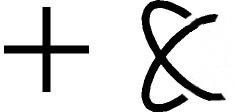
But exactly which assembly is «split» and how remains a mystery. There are some clever and a few rather far-fetched speculations. The question is not exactly at the heart of our paper. We therefore want to escape the impending quagmire at an early stage.
In the Timaeus, the image of a world creation is sketched out on the basis of the musical scale, whose motifs in turn seem to go back to Egyptian traditions. But the Egyptian tradition is also alluded to once again in the following short dialog Critias. Apart from a brief mention in the Timaeus, it is the only literary exposition of the Atlantis myth. The myth is said to have originated from Egyptian sources and was then recorded by Solon, who, however, used Greek names for the inhabitants of Atlantis. These records finally came into the possession of the reporter Critias.
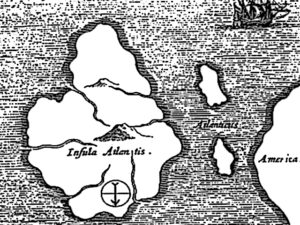
Hardly any other ancient legend has fired the imagination of Westerners to this day as much as the story of the island of Atlantis. Quite a few believe in the historical existence of the fantastic city-state, as vividly described in the Critias. The land, which sank due to earthquakes and floods, was suspected to be in northern Europe, South America, the Caribbean or Asia Minor thanks to the vague reference to «before the entrance of the Pillars of Heracles» and quite a few expeditions have already been equipped to track it down – similar to the biblical Noah’s Ark. Other commentators see the Atlantis myth merely as an intellectual construct that serves to illustrate Plato’s system of state forms.
However, the Rigveda researcher McClain has developed another theory, which is also highly speculative. However, it is interesting and plausible enough to present briefly. Plato presents four model cities in his dialogues: Kallipolis, ancient Athens, Atlantis and Magnesia. The latter is sketched out in the last dialog, the «Nomoi», Atlantis and ancient Athens in the Timaeus. According to McClain, the model cities, all of which also exemplify a certain state model, stand for four different ways of bringing the four prime numbers 2, 3, 5 and 7 into a model (and thus constructing a rational tonal system).
The basic outline of Atlantis is represented by Poseidon, the Greek god of the sea, as follows:
On the sea-coast, towards the middle of the whole island, was a plain which is said to have been more beautiful and fertile than any other. But near this plain, again towards the center, at a distance of about 50 stadia from the sea, there was a low mountain, on which dwelt a man named Euenor, of the number of those who had first grown from the earth, who had Leukippe as his wife. Both produced an only daughter, Kleito. When the girl had already reached the age of manhood, her mother and father died; But Poseidon, seized by love for her, joined himself to her and made the hill she inhabited into a well-fortified one, by separating it all around by larger and smaller belts alternately of water and earth, namely two of earth and three of water, which he carved out of the middle of the island, as it were, equidistant from each other everywhere, so that the hill was inaccessible to humans, as there were no ships or shipping at that time. He himself, as a god, made the island in the middle prosper without difficulty by bringing up two rivers from the earth, one of which gushed warm from its springs, the other cold, and provided the earth with sufficient food of all kinds.
The similarity with the creation of the world soul is striking: the twisting out of 2:3 relationships and the concentric circles can be found there in the whorl and the planetary model, respectively the celestial sphere and ecliptic.
Furthermore, he fathered five pairs of male twins, had them brought up and, by dividing the whole island of Atlantis into ten parts, gave the first-born of the oldest pair the residence of his mother and the part surrounding it, as the largest and most excellent, and made him king of the rest, but the others governors.
The city was subsequently expanded in several stages:
First, they bridged the belts of the sea around the main seat in order to create a path to the outside and to the royal castle. But they built this royal castle immediately from the beginning in this dwelling place of the god and their ancestors; but as one came over from the other, he sought to surpass his predecessor to the best of his ability by further decorating the well-decorated structure each time, until they raised their dwelling to a building that was astonishing in its size and beauty. For from the sea they made a passage 300 feet wide, 100 feet deep and 50 stadia long to the outer belt, through which they paved the way for the entrance from the sea to it as to a harbor, by opening a space sufficient for the entrance of the largest ships.
McClain assumes that Atlantis perished because of its immeasurability, and that this is precisely what Socrates wants to show his disciples. He sees the motivation in the second book of «The State», in which Socrates begins to sketch out the scenario of an immoderate seed in response to his interlocutor Glaucon’s doubts about the ideal, i.e. moderate seed:
«Oh, I see,» I said. «We’re not just looking at the emergence of any state, but that of a lush state. Perhaps that’s not a bad thing. For if we examine it, we may recognize how justice and injustice grow up in the states.»
However, McClain’s theory of harmonious development in antiquity is very complex, so we will limit ourselves here to the main features of his explications.
The mandala-like structure of Atlantis and thus the relationship to the cyclical harmony models of the Rigveda and the Pythagorean world view seem obvious, as do the marriage motif and the procreation of a female offspring as the trigger for the entire development. In the five pairs of twins, McClain sees the generating tones for increasingly finely subdivided scales, which are symbolized by the respective extensions of the city. The innermost ring provides all chromatic material except the tritone, the next outermost ring creates enharmonic substitutions for all tones, until finally the outermost ring creates a system with such fine intervals – namely a subdivision of the octave into 121 tone steps – that the merchants «raised shouting, noise and tumult of all kinds by day and by night».
The refinements lead to ever greater decadence in Atlantic society, which ultimately leads to its downfall.