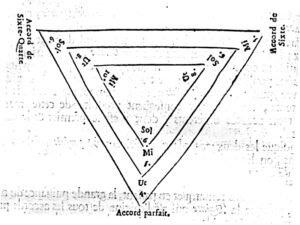
Rameau’s hierarchy of chord variants
Rameau’s great achievement is that he drastically reduces the number of possible basic elements of music. He does this by tracing many chords that were considered different in his day back to others: He recognizes that the layering of a third and a fourth can be seen as another form of layering two thirds, namely as their inversion. He can thus reduce three forms of chords to a single one, each of which takes on a function: In addition to the basic position, there are the inversions of the sixth chord and the fourth chord. They form a well-defined, finite and manageable set of basic elements.
Rameau also draws up a set of rules for musical grammar. Put simply: chords may not be joined together in such a way that octave or fifth parallels are created between their constituents. Sixth-fourth chords may not be «resolved», i.e. they must be transformed into a chord in root position whose root corresponds to the lowest note of the sixth-fourth chord, and so on. There are also rules such as that the end of a composition must consist of a sequence of a chord and a chord a fourth higher (a cadence), or that seventh chords must be followed by certain other chords.
The grammatical metaphor can be taken further: Basic chord positions can be understood as a kind of basic word form and their rearrangements as conjugations or declensions, V-I cadences as «dots» at the end of a «sentence». However, one should not go much further, because there is no need to prove that there is a musical grammar or even to define one clearly. Such an undertaking will sooner or later only lead to difficulties, which lie on the one hand in the fact that the essential elements are not precisely defined, and on the other hand in the fact that the decisive rules in music cannot be absolutely binding or clearly defined.