Until Hugo Riemann, modern theories of music as a language were based on harmonic structures. It was not until the eccentric theorist Heinrich Schenker that the emphasis returned to melody. With him, the first approaches of the second type of grammar – generative grammars – also found their way into music theory. Schenker’s ideas took shape in various publications between 1900 and his death in 1935, but they only found their final form in the posthumously published work «Der freie Satz» in 1935.
Schenker still vacillates between modern analysis and the late Romantic concept of genius, whereby he not immodestly refers to himself as the latter. He sees himself as the completer and corrector of the line that leads from Fux’s counterpoint theory to Johann Sebastian and Philipp Emanuel Bach’s basso continuo theory to his own «free movement». Every man has his time, he quotes the Book of Ecclesiastes. Now it had come to give him the opportunity “to use the new doctrine of organic coherence to say the last possible thing about what the music of the greats was and what it must remain if we want to keep it alive at all.”[3] The last possible thing… So it is only logical when he claims: «Only after appropriating my doctrine will philosophers and aestheticians be able to set out a theory of music as art at all». Schenker’s preface to the «free movement» culminates in the quote: «And the spirit of God floated on the water» – you first have to have that much confidence in your own ideas.
With Schenker, one of the most important concepts in the conception of language finds its way into musical analysis: hierarchy. The fundamental principle of Schenker’s doctrine is that behind the dazzling surface of music there are deeper (and more profound) levels, down to (or up to) an archaic basic structure.
A first impression of what Schenker has in mind, or rather in ear, are the intuitive ideas of musical hierarchies that are familiar to everyone: In melodies, some notes seem to have a constructive meaning, while others are merely decorative accessories. Accordingly, melodies – as well as harmonies and rhythms – can be simplified without losing the basic substance of a work.
The most obvious way to explain this principle is to consider the practice of popular music publishers who produce simplified versions of popular hits for less skilled keyboard artists. Ornaments are omitted, rhythmically complex passages are simplified and the harmony is freed from «decorative accessories».
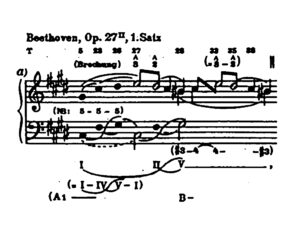
In order to represent the reduction process precisely, Schenker has developed an extremely complicated system for graphically analyzing a piece of music, which, by and large, resembles a fallen tree structure. The more important an event is, the closer it is to the root. The beginning of the «Ode to Joy» from Beethoven’s 9th Symphony can be simplified in the following stages:
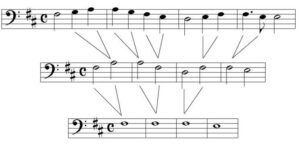 Simplifications of the «Ode to Joy»:
The repetition of each note
is not «essential». The resulting
reduction can be further reduced
to the two «framework» notes of third and second.
Schenker describes the reduction with the help of the tree diagram as follows: The longest branch indicates the lowest-lying event. A first branch points to an event that is hierarchically subordinate to it:
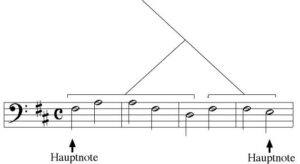
In the example above, the second is
the fundamental event; it follows
from the second reduction that the
third is directly subordinate to it.
A further branch at the first branch denotes an event subordinate to the subordinate event and so on. The hierarchy of subordinations in our mini-example is therefore represented in a Schenkerian analysis as follows:
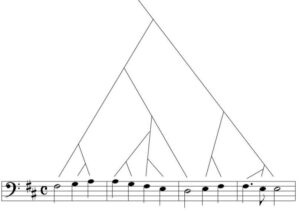
Complete Schenker graph of the example
In the course of his studies, Schenker – inspired by Goethe’s idea of the «Urpflanze» – reduces all music that seems to exist before his strict judgment to a so-called Ursatz as a germinal source:
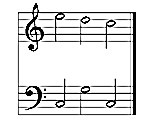
The Ursatz, which Schenker
regarded as the germ source
of all great music. It consists of the
Urlinie in the upper voice
and the bass break in the lower voice.
Although the Ursatz also has variations, it essentially consists of the «Urlinie» of the upper voice, a falling row of third, second and prime of the diatonic scale and the underlying «bass break» of prime, upper fifth and prime. All classical forms such as sonata form, rondo, fugue or song can be derived from the original movement using techniques such as diminuation, arpeggiation, repetition and so on. The original movement and its variants make up the «background». The «foreground» is the actual composition. One or more intermediate levels, called «middle ground» by Schenker, mediate between them.
It is above all the dogmatic tracing back of all serious music to the original movement that has led later commentators – alongside Schenker’s arrogant prophetic gesture – to object. Philosophers may be suspicious of the implicit Platonism in it, namely the belief in eternal, indestructible forms as the actual true things of the world. For the music theorist, the regression seems too narrow a corset when assessing the quality of music. Carl Dalhaus, on the other hand – the «voice of German musicology in the post-war period» – points to an apparent circular argument in Schenker’s reasoning: he gets caught up in the circle of «constructing a secondary course from main tones that legitimize themselves as main tones solely by forming a secondary course.»
Many objections to Schenker’s work stem from pure polemics. However, it is also extremely difficult to make serious and substantial criticism of Schenker’s ideas, as his work is as unsystematic as it is enigmatic and incomprehensible. His rampant vagueness can primarily only lead to a useless argument about who actually understands the master’s ideas correctly.
In order not to do Schenker an injustice, we will let Gerhard Albersheim, one of his own students, present the most important objections. This at least ensures that certain facts can be entrusted to the judgment of a direct witness. Albersheim collected the points of criticism in his book Die Tonsprache (The Language of Music).
«In contrast to Riemann’s static theory of functions,» writes Albersheim, ‘which operates with isolated building blocks of harmonies, he [Schenker] posited the dynamic principle of voice leading, which explains the musical connection between different harmonies as a melodic connection between their tones. Firstly, Albersheim argues that Schenker’s two-part Ursatz fails to recognize that «voice leading in all layers, including the uppermost layer of the Ursatz, is the melodic connection between different successive harmonic structures.» The voice structure of a composition cannot be reduced to a two-part movement. Much of the musical structure can only be explained by characteristics of harmony. Or to put it another way: where Riemann saw only harmony, Schenker wanted to allow only melody to apply. The free melody of a composition is not the same as voice leading. The latter can only be seen in the context of harmonic structures.
Secondly, Albersheim sees the neglect of the rhythmic element as a decisive weakness.
Thirdly, he doubts Schenker’s approach, now referred to as the «top-down approach,» which derives the finer structures from the most general, the «background.» Some of Schenker’s students later abandoned this approach. Albersheim sees the following problems:
- The rhythmic structure can only be deduced from the foreground. To use modern jargon, one could say that the original movement does not contain enough information about the foreground to explain it. This means that certain analyses can be constructed arbitrarily.
- The approach fails to recognize the fact that when we listen, we move from the smallest to the most general. In terms of time, the foreground is what we perceive first. Only when they have listened to a piece in its entirety can they grasp its deeper structure. However, listeners form an impression of the music from the very beginning. They receive the «strongest and most lasting impression» from the «lowest layers of voice leading,» which are immediately apparent to them at the start. It is therefore not necessarily clear why the initial phrase should contain more substance than the foreground.
- The analysis also does not correspond to the creative process. When creating a musical work of art, the composer follows a path from the individual to the general, i.e., he takes the opposite approach to Schenker.
Schenker’s ideas did not find much resonance in Europe. This may be related to the predominance of the twelve-tone school and the migration of important scientific figures to America. In the US, however, Schenker is quite popular. Classical musicians as well as pop artists draw on his work, and important currents in contemporary American music theory are significantly influenced by it.