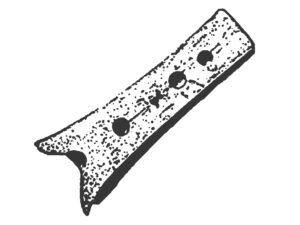
Questions such as: What is the highest mountain in the world? How did the universe come into being? Who shot John F. Kennedy? When was the wheel invented? are often accompanied by questions about the origins of music – namely, the search for a clearly definable but as yet undiscovered reason for the emergence of music among humans. Until not so long ago, there were conflicting theories that believed they had found the only true explanation for the discovery of music, and even today there is still debate about whether the oldest musical instrument (usually a bone flute) has been excavated and what purpose it served (for making music, or perhaps not?). Interestingly, hardly anyone asks what insight into music itself and the history of humankind would be gained if the “mystery” were actually solved.
To come straight to the point: the opinion expressed here is that neither the time of the discovery of music nor the manner in which it was discovered are really of interest. The closest we can probably get to the truth is a conception that assumes that different groups of early humans arrived at music in very different ways, possibly lost it again and then rediscovered it. Because we will never have any audible evidence of prehistoric music, we cannot use it as a clue in the search for universal principles in music.
An overview of the prevailing theories of the origins of music at the beginning of the 20th century is provided in the short work “Die Anfänge der Musik” (The Beginnings of Music, 1911) by Carl Stumpf.
First, there is Darwin’s theory of evolution, which demands that music must have some kind of survival advantage. Since the “indefinable, objectless air formation that we call music” is not related to the real utilities and needs of everyday life, a little mental acrobatics is required. The key lies in reproductive behavior:
The males strove to please the females, and the females chose those who showed the greatest advantages. Just as the most beautiful in form and color were preferred, so too were the best singers or roarers preferred from time immemorial. Among animals, we therefore find that the male sex is predominantly colorful and fond of singing.
Stumpf is not entirely convinced by this theory. For one thing, he points out that birds often sing outside the mating season and that animals closest to humans make sounds that are decidedly unaesthetic. Furthermore, he argues that “the songs of primitive peoples are not predominantly love songs, but rather, in large numbers, war songs, medical songs, and religious songs.”
An important objection also arises from the observations made during the very early days of ethnomusicological recording: Since the playback devices for phonograph cylinders did not have a standard speed, researchers used a whistle with a fixed pitch to whistle a reference tone onto the cylinder before recording so that they could later determine the absolute pitch at which the singers had performed. They observed that the indigenous singers often adopted the whistle tone as the fundamental tone of their songs. Stumpf was convinced that this ability to transpose did not exist in the animal kingdom (as we now know, he was mistaken—Mâche, for example, mentions Hylobate and Lanius minor as transposition artists). For Stumpf, this absence is proof that animals do not perceive music-like expressions on an abstract level as “general concepts”:
Music is similar to language. Animals also have a language. But language in our sense only begins where sounds are used as signs of general concepts, an application that is as little proven in animals as the use of transposed intervals. What we have inherited from our animal ancestors in both respects is only the larynx and the ear.
However, Stumpf overlooks the much more important objection, namely the fact that the assertion that better singers have better chances of having sex merely shifts the problem: If the only effect of better singing is the ability to impress potential sexual partners, then the question of survival advantage is left out of the equation and singing becomes an erotic conquest strategy without any real depth (a theory that would certainly support today’s music business). The real survival advantage of a good singer must lie in a non-musical skill that singing merely points to, such as exceptional intellectual agility (which, again, would be refuted by today’s music business).
According to Stumpf, another way of deriving music from the animal kingdom is the idea of the ancient Greek philosopher Democritus, who believed that music originated as an imitation of birdsong. In this regard, Stumpf makes an interesting observation. Namely, that “natural people” do not necessarily imitate the singing of birds, but rather percussive sounds (Stumpf calls them “rhythmic”) such as trills and clicks. Moreover, even the idea that melodies were imitated does not answer the question of why our scale system should have resulted from this.
A theory that differs from evolutionary approaches is that of Rousseau and Herbert Spencer, which Stumpf sums up as “In the beginning was the word”:
It teaches that music originated from the accents and intonations of human speech. These tonal qualities become more pronounced when we speak excitedly, under the influence of strong emotions. When we call someone and, if they do not come, call them a second and third time, or when we ask or command with increasing emotion, when we rejoice or mourn in words: according to Spencer, language always becomes musical; we begin to sing. These tonal movements of excited speech were later completely replaced by words and transferred to instruments, and thus absolute music came into being.
However, according to Stumpf, the theory of Sprechgesang fails to explain the quantum leap from approximate pitches to a fixed scale system:
The law and spirit of musical art require fixed pitches and intervals as a matter of principle, and the intention of the singer and player is directed toward their production, apart from exceptional cases. In language, on the other hand, such an intention does not generally exist and must not exist if it is not to sacrifice its best. (…) If language somehow helped in the birth of music or in its upbringing, it was certainly not the mother. What fundamentally distinguishes music from language cannot be derived from language.
This leaves a third source of origin, which Stumpf characterizes with the words of Hans von Bülow: “In the beginning was rhythm.” According to this theory, music grew out of all kinds of rhythmic activities, especially coordinated physical work such as drumming, rowing, and so on. The objection is similar to that against the second theory, quite apart from the fact that rhythm is actually a much more general concept than just an acoustic one:
But even the most finely differentiated drum sonata is not yet music, at least not the music whose origin we are seeking. After all, rhythm exists not only for the ear, but also for the muscles alone; and if the whole of humanity had remained deaf forever, it could well have developed a dance art, but not music. The primordial seeds of musical scales must have arisen independently; only then could the melodic interact with the rhythmic need (which may well have existed earlier).
Instead of recognizing that a monocausal theory of the origin of music must inevitably lead to a dead end, Stumpf simply adds another monocausal explanation to the list, which, moreover, is no more plausible than any of those previously mentioned. According to Stumpf, the root of music is signaling. If you want to give a signal with your voice over a greater distance, you automatically linger on one note. Stumpf interprets this as the first step toward singing, which draws the line between singing and mere speech. The actual act of creation occurs when several people call out together to amplify the signal.
If they are men and boys or men and women, they will produce tones of unequal pitch because each person can only reach the highest pitch within their own vocal range. This may have led to countless polyphonic sounds arising by chance.
It is difficult to accept this explanation as highly plausible. Moreover, it is worth experimenting to see whether this is actually the case. One must also assume that a group of people who want to produce a strong signal for communication are not in the mood to make music. On the contrary, naked pragmatism is likely to prevail.
It seems much more plausible that harmonic relationships were discovered in a variety of ways: by blowing into flute-like vessels, by perceiving overtones in the head when a song-like tone was intoned, and so on and so forth. Stumpf was probably unconsciously influenced by the prevailing view in Europe at the time that music meant above all singing.
The origins of music will probably always remain a mystery, and this is not particularly regrettable, because it is fairly irrelevant how and when humans discovered it. Much more important is the question of what similarities exist between the music of peoples scattered across the globe. The practices vary so widely that one must first find characteristics that are common to all and that could ultimately help to define the term “music” in a meaningful way.
However, the American ethnomusicologist Bruno Nettl first takes up the widespread opinion that ethnomusicologists rack their brains over the origins of music. In the article “An Ethnomusicologist Contemplates Universals in Musical Sound and Musical Culture”, he describes how the New York Times and newspapers in Toronto published an article about the discovery of what is believed to be the oldest flute (didn’t we know that?) on the occasion of a congress of the Society for Ethnomusicology. The discovery was not discussed at all at the conference itself. According to Nettl, ethnomusicologists are not concerned in any way with the question of the origins of music. If anything, they are more interested in the myths surrounding it, which may provide clues as to the role music plays in the corresponding contemporary culture.
After Stumpf’s publication, Nettl explains, interest in the origins of music declined dramatically. In fact, the lively discussions surrounding the Berlin circle of Carl Stumpf, Robert Lach, Erich von Hornbostel, Otto Abraham, Curt Sachs, and Marius Schneider came to an abrupt end with the Second World War. Later, it also fell into disrepute because of its proximity to racial theories. It did not even require official condemnation of the subject, as was pronounced in 1866 by the Société de Linguistique de Paris for linguistics.
Nettl is suspicious of the search for universals as the basis of ethnomusicological theory:
We could conceive of music as a single large complex of sounds and ideas, a kind of universal language of humanity, and if we were to accept such a thing, it would lead us to construct universals in a very specific way.
Nettl rejects this, but without realizing that he has already made a momentous preliminary decision—precisely because he dismisses the problem too early: He makes the following suggestion:
A more typical ethnomusicological view would envisage a world of music consisting of large groups of discrete musics, in some respects analogous to language, with stylistic, geographical, and social boundaries.
Even if restrictions have to be made, it is still possible to talk about music in terms of language. Ironically, it is ethnomusicologists, who have to cover the widest conceivable range of musical expressions, who are supposed to make a preliminary decision and limit their field to the linguistic metaphor, which already represents a relatively high cultural achievement.
Nettl makes an important observation, however. He points out that the cultures of the world do not have a uniform concept of music. Some include dance, singing, and related rituals, while others know more than just one type of “music.” Persian musicians, for example, distinguish between Musiqi and Khandan. The latter means reading, reciting, and singing. Cultures also distinguish between functional and art music, as in the German terms “Musik” and “Tonkunst.” However, according to Nettl, all cultures have a form of acoustic communication that can be distinguished from ordinary speech. This offers itself as a candidate for the definition of a universal – with the caveat that certain cultures have several such forms of communication, for example some Indian tribes in Ecuador, who, like Japanese monks, use certain musical phrases for recognition.
Another important point made by Nettl is the observation that all societies do not simply sing and play, but sing and play something, i.e. music is understood as a kind of object or entity.
Nettl rejects the possibility of defining universals in music in normative terms and offers a kind of statistical substitute. Without speculating on whether this could apply to every possible or unknown culture, he makes the following empirical observations. According to Nettl, all known cultures have:
- Vocal music
- Instruments (at least in the form of primitive percussion instruments)
- Meter and/or pulse
- A (sub)system of only four or five tone steps, with intervals that correspond approximately to semitones and whole tones
- The embedding of music in rituals and in invocations of the supernatural
- The consciousness-altering effect of music
- The accentuation of important events such as births, gatherings, and so on with the help of music
Not universal, however, is singing in octaves by men and women. The use of a set of discrete interval classes (scales) is also not universal (unfortunate for Sebastian von Hoerner and the aliens). As a counterexample, Nettl cites the songs of the Samaritans near Tel Aviv and Nablus, who do not use distinct interval classes.
However, Nettl believes that most cultures have a kind of subclass of music, which he describes as the “simplest musical style in the world.” It consists of songs that repeat a short phrase several times and are played within the range of a fifth. Their widespread distribution and the connection they usually have with traditional rituals suggest that these are the oldest musical forms. Nettl counters this by arguing that Europeans tend to place great importance on interval structures and melody, and that widespread distribution alone is not an argument for age. For example, a researcher from the distant future might conclude from archaeological excavations that the 20th-century piano is one of the oldest musical artifacts.
All these considerations lead Nettl to the conclusion that the search for reliable universals in the form of structural features is practically futile. Nevertheless, he believes that the problem is too important to be left unresolved.
In another article (“On the Question of Universals”), Nettl distinguishes between several types of universals and the problems they pose: when searching for characteristics that are common to all types of music, he explains, we are faced with the problem of individualizing musical works. For example, is an opera a single musical expression or an accumulation of such expressions? As a rule, we can decide after a few moments whether something is music or not. According to Nettl, the best starting point is to take a large collection of music found on the planet. All of them—there may be hundreds, and no one has an overview of them all—have their own rules. From these, it should be possible to distill cross-conceptual general characteristics. Nettl mentions the following as candidates:
- A kind of major second as the preferred interval in singing
- Descending tendencies at the end of a piece
- Repetitions
- The principle of variation
- Rhythmic structures
Added to this is a general view that music is a kind of art form, i.e., an artificial thing. In addition, music is usually very closely linked to dance and lyrics. Finally, Nettl lists the positions that can be taken with regard to the origin of universals:
- They may have their cause in the deep structure of the musicality of human nature.
- They may have arisen from contact between cultures.
- They can be explained with the help of physiological and anatomical theories.
- Finally, evolution can be invoked as an explanation.
Interestingly, in his final speculations, Nettl returns to the ethnomusicological truism that early music was somehow connected to rituals. However, he also argues that the thesis that music had a monocausal origin should be questioned.