The stagnation of reasoning
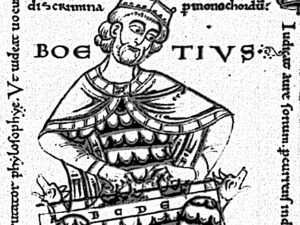
Throughout the Middle Ages, the European music world was primarily guided by one work, the «Five Books on Music» by Boetius (ca. 480 – 524 AD), who in turn was mainly based on Ptolemy. This Neoplatonic thinker is primarily known to wider circles for his work «The Consolation of Philosophy». Boetius’ life was quite eventful. The son of a Roman consul, he was given a careful education, which made him one of the most educated men in Rome. The Ostrogoth king Theodoric entrusted him with the regulation of coinage at a young age, and the Burgundian king Gunobald asked him for a water and sundial. The highly respected scientist, who was himself appointed consul, later fell out of favor and was accused of high treason. The «Consolation of Philosophy» was written in prison before his execution in Pavia.
Boetius popularized the division of music into musica mundana, musica humana and musica instrumentalis, which prevailed until well into the modern era. The first is the music of the universe or music of the spheres, the second is a reflection of the first in human dimensions and the third is that which is produced by humans. To prove the existence of a musica mundana, Boetius resorts to the logical conclusion of contradiction: as we can all observe in the sky, the celestial bodies move extremely quickly; it is inconceivable that such a movement would not produce sounds. As the orbits of the celestial bodies are now in harmonious relationships with each other, harmonious music can even be heard.
The most interesting chapter of the «Five Books» in terms of music aesthetics is the 34th of the first book, entitled «What a musician is». Here Boetius ensures that the disdain for the practical musician is maintained throughout the Middle Ages and well into modern times. It is, he believes, «far more important and sublime to know what every practical artist does than to do it oneself.» Science is «the mistress of practical execution». Boetius’ privileging of the intellectual goes so far as to claim that scientific research does not require practical execution. Under certain circumstances, it even interferes with it, for example when the exact interval ratios have to be determined. The ear is always wrong, only logical observation leads to the realization of the true relationships.
According to Boetius, the medieval hierarchy of musicians was as follows:
So there are three classes that deal with music. One deals with playing instruments, the other composes songs, the third judges instrumental performances and the composition of songs.
Now those of the first class, i.e. those who occupy themselves with playing instruments and devote all their efforts to it, for example the zither players, or those who demonstrate their art on the organ or other musical instruments, are far removed from a deeper insight into musical science, because they, so to speak, only serve and do not apply any science, but are entirely indifferent to all research. The second class of music-makers is that of composers, who arrive at the production of a song more by natural instinct than by scientific research, which is why this class is also to be separated from music (i.e. regarded as a science). The third class is that which has a sure experience of judgment, so that it can weigh rhythm, melody and the whole composition. This class, since it is entirely concerned with scientific research, actually belongs to music. He is therefore a musician who possesses the ability to judge according to scientific research and rules in music about key and rhythm, about sound genders and their mixture, about the songs of the composition, in short about everything that we will develop later.
Today, we probably no longer take such a narrow view.
At the beginning of the fifth book, Boetius sets out in detail what is to be thought of practical experience. The harmonious faculty has two instruments, feeling and reason. Feeling perceives something, but it is still imprecise and confused. Only reason recognizes the truth on the basis of emotional experiences and their interpretation.
Boetius illustrates the relationship between feeling and reason with the following example: finding a larger or smaller line for a given line is easy for the mind. If you want to find one that is larger or smaller by a certain amount after a certain measurement, only mental work can help: you have to measure and have a theory of measurement whose correctness you have shown logically.
It was not until centuries after Boetius that new aspects of musical aesthetics began to open up – with the Scottish monk Johannes Scotus Eriugena: Eriugena attempted to reconcile Neoplatonic ideas with Christian thought. Eriugena’s life is also eventful. He was born a Scot in Ireland around 800 and was entrusted with the management of a school in Paris by Charles the Bald in 843. There he played a key role in the notorious universals dispute between the nominalists and realists.
The problem of universals arose from the confrontation between the works of Plato and Aristotle. Plato took the realist position that general concepts or «ideas» constituted true reality, while Aristotle saw general concepts merely as abstract names and, as a nominalist, believed that only individual things were real. Eriugena himself took a decidedly realist position, which promptly earned him the accusation of being a heretic who merely produced «Scottish porridge». His basic thesis is that biblical revelation and rational philosophy are on an equal footing, but that rational philosophy, as the embodiment of reason, has the advantage when the two come into conflict (incidentally, this motif can be found in Umberto Eco’s bestseller «The Name of the Rose», which was made into a film starring Sean Connery). Such ideas are seen by the clergy as an attack on their own power. Incidentally, the Catholic Church only came to terms with the primacy of science over theology at a very late stage.
Eriugena also earned his merits as a translator of the ominous «Corpus Dionysiacum» by Dionysus Areopagita. It inspired him to write his work «De divisione naturae», which introduced a Neoplatonic hierarchy into Christian theology. Above all, however, he brought a new perspective to the structure of the harmony of the spheres. In Eriugena’s cosmology, only the moon, Saturn and the fixed star sphere revolve around the earth. The other planets revolve around the sun, which in turn also revolves around the earth:
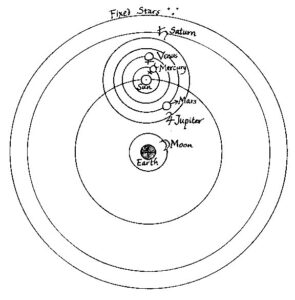
The moon, sun, Saturn and fixed stars revolve
around the earth, the remaining planets
around the sun.
However, his discussions on the actual harmony of the spheres are very sparse and can only be found in commentaries on the work of the thinker Martianus Capella. According to his conviction, the fixed star sphere revolves fastest around the Earth, followed by the Moon. Saturn is the slowest. His system of assigned intervals has a range of two octaves. He also assumes that the sound produced by the spheres is not static, but remains dependent on the position of the planets. For example, when the sun and Saturn are furthest apart, they produce an octave; when they are closest together, they produce a fourth. This was to remain the only real modification to the system of spherical harmony until the 15th century. It was not until 1434 that Giorgio Anselmi of Parma again developed a concept of celestial sound in line with the spirit of the times – as a contrapuntal interplay.