
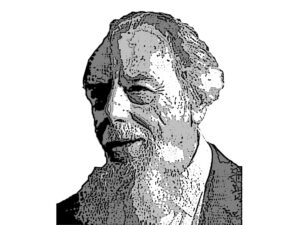
One of the most colorful personalities in contemporary music aesthetics is Australian researcher Manfred Clynes, who is variously described in the press as an aeronautical engineer, philosopher, physician, neuroscientist, mathematician, and concert pianist—and who is all of these things. As a musician trained at the renowned Juilliard School, his teachers included Pablo Casals and Edwin Fischer. As a neuroscientist, he invented a CAT computer (Computer of Average Transients) to measure the brain’s response to various stimuli. It remained a standard measuring device in laboratories around the world for decades.
In the early days of the internet, a neologism coined by Clynes in 1960 during a discussion about space travel became infamous among the general public: “cyborg” (from “cybernetic organism”). This refers to a synthesis of humans and technology. In speculations that still seem fantastical today, Clynes (together with his Australian colleague Nathan Kline) envisioned an astronaut adapted to life in space through drugs and surgical interventions. Later, the term became a weapon of postmodern culture, which sees the technically designed fellow citizen as a non-conformist social minority, much like drug users, the gay subculture, or artist communities.
Clynes’ contributions to what he calls “sentics” are interesting for the study of musical meaning, and he was literally laughed at at scientific conferences in 1968 when he presented his ideas. Clynes’ basic thesis is that the expression of human emotions has a fixed, biologically based dynamic form. This form can be proven experimentally and is also independent of cultural influences. Moreover, it is well-defined and clearly delineated—even more precise than the words we use to describe it. It can best be compared to hard-wired programs that run automatically once they have been initiated.
The theory of sentic forms allows Clynes to develop an astonishingly simple, mechanistic theory of emotional expression in music: if a performer or even a computer succeeds in reproducing the sentic forms in music as accurately as possible, then, according to Clynes, they have achieved perfect expression. This must be taken literally; Clynes is convinced that there is such a thing as a biologically exact reproduction of sentic forms and thus also a criterion for a “correct” reproduction of musical expression. If a performer reproduces individual notes or phrases exactly in accordance with the sentic forms, the music sounds alive and the interpretation coherent. In the most radical case, this can lead to a mechanized way of evaluating interpretations: first, the sentic forms encoded in the music are identified, and second, it is checked whether the performer reproduces them exactly according to the biological model. If this is successful, then the ideal, perfect interpretation has been achieved.
Clynes illustrates this conviction with a phenomenon familiar to all musicians:
A few years ago, the master Pablo Casals was giving master classes for cello at his home in Puerto Rico. On this occasion, an outstanding participant played the theme of the third movement of Haydn’s cello concerto, a graceful and joyful theme. Those of us who were there could not help but admire the grace with which the young master cellist played.
Casals listened attentively. “No,” he said, waving his hand—one of his familiar, unambiguous gestures—“that must be graceful!” And then he played the same few bars—and it was as if we had never heard grace before, so graceful that the cynicism in the hearts of those sitting there listening melted away. This single phrase pierced all the defenses, the armor, the hardening of the heart that we usually carry with us, and with its power transformed us into people who were happy to be alive.
What was this power that brought this about? A small difference between Casals’ phrasing and that of the young man. A small difference – but an enormous difference in terms of communicative power, magic, and transformative effect.
Clynes’ theory sounds rather provocative and “unmusical” to traditionally trained musicians. Contrary to the common belief that the mental makeup of conscious human beings is far too complex and profound a phenomenon for a machine to ever comprehend, emotions are considered profound, multi-layered, and ultimately unfathomable.
While playing around with the CAT computer, Clynes discovers that all people react to certain colors with the same predictable brain patterns. This gives him the idea of constructing a measuring device that can record inner mental states via finger pressure patterns. The result is a box called a “Sentograph,” which accurately records how a test subject translates different stimuli into finger pressure patterns.
Finally, Clynes goes one step further. He hypothesizes that specific feelings correlate with very specific pressure patterns lasting between one and ten seconds. These are not perceived symbolically, but directly via the central nervous system, i.e., without the mediation of cognitive processes.
To prove his hypothesis, Clynes sets off with the Sentograph to hunt for universal emotional patterns in a wide variety of cultural settings – Mexico, Japan, and Bali. In doing so, he finds what he is looking for (at least in his own opinion) – the experiments seem to confirm that sentic forms are independent of cultural conditions.
In 1977, Clynes formulated the characteristics of the communication of emotional content (senthetic states) with the help of senthetic forms with the following features:
Exclusivity: The communication of senthetic states is a single-channel process, meaning that only one emotion can be communicated at a time.
Principle of equivalence: There are several equivalent motor expressions for the expression of a senthetic state.
Coherence: The dynamic expression of a sentic state is controlled by a brain program or algorithm called the “essential form.” There is an innate coherence between the essential form and the emotion that seeks expression through it.
Complementarity: The creation and recognition of essential forms is controlled by a data-processing program in the central nervous system and coordinated biologically so that a precisely produced essential form is understood accordingly. The recognized form produces the corresponding sentic state in the observer.
Self-generation: The intensity of sentic states is amplified within certain limits by arrhythmically repeated generations of the sentic form. (One becomes increasingly absorbed in something…)
Generalized emotions: Senthetic states can be experienced as pure qualities or identities without having to be traced back to specific causes (i.e., one can experience joy or sadness in music without there being a concrete reason for it in one’s current life).
Communicative ability as a function of formal fidelity: The ability of sentic forms to generate sentic states grows to the extent that the forms approach an idealized form.
Clynes also set out to decipher the very specific sentic forms associated with some fundamental human emotions. In self-experiments, he designed sentograms for anger, hatred, grief, love, sexual desire, joy, and awe, which can be drawn as follows:
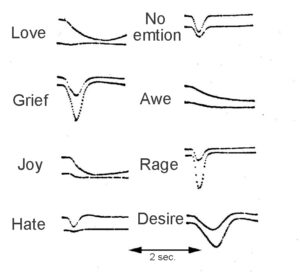
Horizontal and vertical
components of sentic forms
The upper curve traces the course of the vertical component of the finger pressure, the lower curve traces the horizontal component. Anger can thus be characterized as a violent double press in both directions, grief as a short initial burst followed by slow relaxation. The movements are all intuitively plausible. Basically, they simply expand a repertoire of immediately recognizable emotional expressions that are commonly known, such as laughter or fear.
Based on the sentic forms, Clynes hopes to define a form of communication between humans and computers that no longer feels mechanical, but gives people the impression that they are communicating with a sentient being when they come into contact with a computer. He goes so far as to design computers in his mind that have an individual character profile – predefined user settings, so to speak – depending on the human conversation partner, in order to appear as understanding as possible.
Clynes confronts numerous test subjects – mainly students and employees at Australian universities – with these patterns, all of which they can identify with a high degree of certainty; only love and awe are occasionally confused. To see whether recognition is culturally dependent, Clynes conducts the same experiment with Australian Aborigines who have had little contact with white civilization. They too correctly classify the patterns with a high degree of certainty.
In music, Clynes believes he has identified another type of typical “signature,” which he calls the “inner pulse” and which is based not least on the experiments and observations of the German musicologist Gustav Beckings.
He recalls that Beckings liked to ask musicians to conduct compositions with their index finger. He noticed that the accompanying movements were always similar for individual composers. Clynes transfers Beckings’ idea to the Sentograph. In an initial self-experiment, he confronts himself with music by Beethoven, Schubert, and Mozart. He actually seems to express their styles with characteristic pressure patterns.
Intrigued, he persuaded pianist Rudolf Serkin to try the same experiment. Serkin took a more humorous approach and thought of Mozart when Clynes asked him to think of Beethoven. With the help of the Sentograph, however, Clynes exposed the deception, much to Serkin’s amazement. The following serious series of tests showed that Serkin produced the same pressure patterns as Clynes for the individual styles. Even Pablo Casals, who is certainly not suspected of emotional simplicity, produced the same results on the Sentograph. This gave rise to the hypothesis that pressure patterns and musical expression must have their origin in the same brain functions.
The inner pulse—today we might call it “groove”—is a kind of rhythmic fingerprint of the composer that is constantly repeated in his works and constitutes their unique fascination. It can also be seen as the canvas on which the composer paints his works:
The inner pulse consists of an alternation between two phases, which we can refer to as active and rest phases. It is important to note that the sentic charge of the inner pulse results in a specific form of the pulse itself. The pulse takes shape, so to speak, through the composer’s handwriting. However, it is not just like his signature; it is also a sentic matrix that represents his personal perspective or identity. We feel it as the composer’s “presence” or “personal charisma.” Without it, a piece of music may be reproduced “correctly,” but it does not convey the immediate, intimate experience of the composer’s charisma. The inner pulse is a key to empathy, to understanding the composer. It allows us to grow fond of the composer as a person.
Clynes estimates that only a small portion of the information conveyed by an actual performance of a composition is determined by the score of the piece. Expressed in the language of information theory, he explains that 10 bits of information per note are contributed by the score and 17 bits by the performer. Clynes calls the performer’s contribution the micro score. It determines the fine structures that cannot be captured by the relatively coarse notation. These include the exact volume of a note, its exact duration, crescendos, diminuendos, delays and accelerations, and the vibratos and volume envelopes that bring a note to life.
All this additional information can be divided into five areas: loudness, deviations from the duration specified in the notation, volume envelope, timbre changes within a note, and the shaping of the vibrato.
Clynes did not stop at theoretical considerations. He wrote a commercially available software called “Superconductor” that claims to put his findings into practice. It uses instrument samples and a MIDI sequencer to bring classical works to life. However, Superconductor goes beyond simply converting the score into MIDI tracks. First, the result is given a tempo that suits the composer. Various algorithms also shape the sensitive parameters, especially the volume envelope, in accordance with the idea of sentic forms. Clynes somewhat immodestly claims to have found the interpretive Holy Grail, because Superconductor should be able to perfectly implement sentic forms without any motor deficiencies or concentration problems. The owner of the software can experiment with different settings and fine-tuning, thus becoming an interpreter themselves without having to master an instrument. The idea has something appealing about it. Whether all this works is up to each individual to decide. In our own experiments with Superconductor, we came to the conclusion that the pulse is overemphasized in Clynes’ own interpretations and begins to grate over time. This seems to be due to the fact that, despite everything, the concept is applied too mechanically. However, Clynes does not necessarily concern himself with trivialities when coding examples. One of his larger projects is the late Beethoven quartets. On the other hand, the results are astonishing, and one gets the impression that Clynes is on the right track.
One of the first to defend Clynes’ ideas is Marvin Minsky, the grand old man of artificial intelligence (AI). Like Clynes, Minsky is a determined and enthusiastic lateral thinker, and his efforts to teach computers not only to think but also to feel are viewed with considerable skepticism by contemporary commentators. In the course of his lifelong research, however, Minsky came to the provocative conclusion that the human emotional universe is basically very simple and that it is precisely intellectual achievements that make human existence so complex and unfathomable. Unlike emotional reactions, they are also extremely difficult to translate into computer models.
However, there is still healthy skepticism toward all forms of “scientific” categorization of feelings. Too often, such categorization has been used as an unfair means of forcing people into unsuitable schemes or even excluding them politically or socially. Manfred Clynes hardly belongs in such an environment, if only because he has put himself on the outside with his theories. On the other hand, he himself is caught up in a traditional understanding of music that limits the interesting part of the phenomenon of music to European art music between Gregorian chant and 20th-century tonality.
Whether or not one finds Clynes’ practical results and classifications convincing is not the point. The experimental findings are a serious attempt to move beyond Hanslick’s verdict and, to a certain extent, place Cooke’s undertaking on an experimental basis: instead of limiting themselves to “dynamic forms” that can be used for a wide variety of emotional expressions, movement patterns are associated with specific emotions. This is made possible by a physiological-psychological framework theory, which may not yet be entirely convincing in its specific findings, but which could potentially open the door to a deeper understanding of the connections between emotions, expressiveness, and musical experience.
However, it is also important to note that this does not make music a language of emotions. Clynes does not see any mechanisms for combining individual movement patterns into more complex statements. At most, if one wishes to do so, one can see certain parallels to Leonard Meyer’s theories when Clynes notes that the juxtaposition or repetition of sentic forms arouses certain expectations that can be deliberately disappointed for the purpose of creating an effect of surprise. And yet, even though Clynes provides an approach to explaining how music can express concrete feelings, he does not stray too far from Hanslick. For Clynes, too, the emphasis is not on communicating a concrete emotion, but on the play of forms that moves us as such, only that the formalized basic emotions are part of the forms.