At the dawn of the middle ages
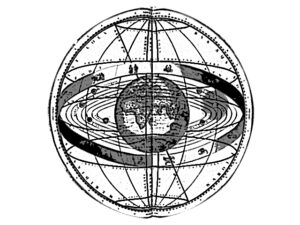
From antiquity to the Middle Ages, the ideas of harmonics and the sounds of the spheres reached us via Claudius Ptolemy, who was active at around the same time as the Apocalypse of John was written. In medieval depictions, Ptolemy is sometimes depicted with a crown on his head because he is confused with the members of a Hellenistic-Egyptian ruling dynasty. However, he has nothing to do with them. He worked as an astronomer, mathematician and geographer in Alexandria around 160 AD. His main astronomical-mathematical work is the «Mathematike Syntaxis», which later became a «great syntaxis», which the Arabic translators eventually even turned into a «greatest syntaxis». The corresponding expression is «megiste». With the typical Arabic «Al», the name «Almagest» was therefore coined for the «syntaxis». The Almagest remained the reference work for the geocentric world view for almost 1500 years.
According to the official version, the work is the achievement of Ptolemy himself. However, as early as the beginning of the 19th century, the French astronomer Jean Delambre proved that much of the data was either fictitious or copied from Hipparchus of Nicaea (2nd century BC). The brazen fraud was confirmed by van der Waerden in his book «The Astronomy of the Greeks».
Incidentally, Ptolemy also recorded the known world at the time in a huge work of maps, the «Introduction to Geography» in eight volumes. In general, Ptolemy’s merit lies in consolidating the scientific data of his time. He did this so thoroughly that some of the data providers have simply been forgotten.
Incidentally, the data theft does not concern his theory of harmony, in which he meticulously explicated the systems of Pythagoras and his chroniclers Archytas, Plato, Aristoxenos and Eratosthenes and supplemented them with his own – inferior – interpretations of the tonal system. However, harmonics did not receive the attention that the Almagest and geography did. There is a «new edition» from the 13th century by the historian Gregoras, but otherwise the work has a rather marginal existence. The authenticity of the sketches for the third book, in which the relationships between intervals, the soul and celestial bodies are explained, is also questioned from time to time because they are far less concise and more fragmentary than the rest. They also lack the polemical bite that characterizes other parts of the work.
The architectural plan of the theory of harmony is as follows:
- In Book I, harmonies and sounds are defined. Starting from the distinction between discrete and continuous sounds, Ptolemy outlines a theory of the relationship between intervals and mathematical ratios. The end of Book I is a discussion of the tetrachord and its different construction by Archytas, Aristoxenos and Ptolemy’s contemporaries.
- Book II deals with scales and their variations.
- Finally, Book III outlines the theory of spherical harmony as it was to remain valid for the next 1500 years. It already contains the order of the medieval quadrivium of arithmetic, geometry, astronomy and music, which was only later institutionalized by Boetius.
The Syrian Greek Nicomachus of Gerasa made a significant contribution to the legends surrounding the Pythagoreans. Around the year 100, around the same time as the Apocalypse of St. John, he wrote a standard work on arithmetic as well as a book called «Manual of Harmonics», which is actually nothing more than cursory notes on an introduction to harmonics for a friend.