
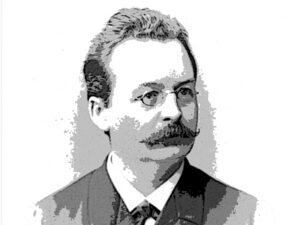
Riemann’s musical syntax
Harmonic grammar was perfected and still taught today in the works of Hugo Riemann, which were written around the turn of the 19th and 20th centuries. There is a historical reason why the further development of Rameau’s ideas took so long: Rameau did provide the essential elements of functional harmony. However, his quick-tempered and opinionated nature did the dissemination of his ideas a disservice. In his old age, he began to isolate himself and clash with everyone. He refuses to write an article for the famous French «Encyclopédie» and engages in fruitless intellectual battles with its protagonists D’Alembert and Rousseau. The whole thing ends in mutual accusations of incompetence. As a result, no one has much desire to really engage with Rameau’s ideas or to take up the cudgels for them. The basso continuo system therefore survives on a theoretical level much longer than necessary.
Hugo Riemann thus found himself in a situation at the end of the 19th century due to baroque querulousness, which he described as follows in the preface to the third edition of his «Handbuch der Harmonielehre»:
When I published my «Sketch of a new method of teaching harmony» in 1880, it was perfectly clear to me that it would be very difficult to replace the basso continuo method, which had been established throughout the civilized world for almost three centuries, with a completely new method of teaching harmony. Despite this conviction, I did not follow the advice of well-meaning friends who recommended a middle course, namely a cautious preparation of the desired reforms through a gradual reorganization of figured bass.
Rameau contributed to the theory of harmony with the doctrine of chord inversions and the foundations for major/minor tonality. The system was completed by Riemann, who added the theory of the tonic, dominant and subdominant functions and, above all, the idea of the cadence.
Unfortunately, Riemann’s thought structure cannot be presented without an important digression on his construction of the minor scale, and it is precisely this that forms the downer in his brilliant train of thought. With his conception of the major/minor duality, Riemann gets lost in an idea that is neither theoretically nor practically useful, but prevents him from giving a concise and elegant description of minor tonality. Since he also consistently adheres to his idea formally, he ultimately ends up with counter-intuitive assertions, the defense of which at times takes on the traits of scientific satire.
The basis of his idea of the origin of the minor chord is a speculative undertone series.
The well-known, physically easily ascertainable overtone series is generally agreed to be the basis of the major chord.
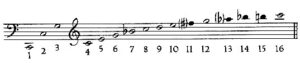
which Riemann derives
the major sound.
The overtones 4, 5 and 6 together form the major chord (in the example the chord c – e – g).
Instead of defining the minor scale and minor chord as a parallel key on the sixth degree of the major scale, as is generally the case today, Riemann postulates a speculative undertone scale:
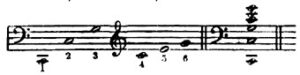
series from which Riemann
derives the minor tone.
The assertion: So-called undertones, which are an exact mirror image of the overtone series, resonate under each tone. The minor chord is derived analogously from the undertones 4, 5 and 6, in this example a – c – e.
Riemann met with little approval from his contemporaries and later generations. Despite all the criticism and the obvious difficulty of physically proving the existence of an undertone series, Riemann stuck to his conviction – even against all odds. For example, in his otherwise extremely modern, even avant-garde-seeming essay «Musical Syntaxis», he describes his efforts to make an undertone series audible on the piano:
I have the peculiar experience that when I play a g’ on the pianoforte, which I mute immediately after a strong touch, I hear a faint but clear c, which of course disappears very quickly, from which note I have raised the mute by pressing down the bars. This c has exactly the same ethereal, disembodied sound as the combination notes and is easy to confuse with its higher octave (c’). I intend to repeat these experiments many times to make sure of the results: if I succeed, then we are a big step further; for I hear not only C in the above case, but also E flat, and strangely enough, it is precisely the wound strings that respond excellently and resonate longer than the simple ones. Whether these softly resonating undertones are merely an accidens of the partial vibrations of the strings when they resonate, or whether the undertones are already contained in the sound of the originally struck string, mathematical mechanics may prove more precisely.
In a supplement to «Musikalische Syntaxis» he insists:
Prof. von Oettingen [ meant is his teacher Arthur von Oettingen] tells me that he was unable to hear the undertones on his Breitkopf and Härtel grand piano (mine is by Ernst Irmler) even when it was silent all night. On the other hand, I have heard from several young friends that they succeeded in the experiment immediately. Be that as it may, and if all the authorities in the world appear and say “we hear nothing”, I must say to them “I hear something, and something very clear”. Incidentally, Prof. v. Oettingen does not doubt my discovery, he just can’t listen to it for the time being [!]
The stubborn adherence to the undertone principle reaches deep into the structure of Riemann’s music theory, for example when it comes to forming cadences. In line with the rest of the musical world, Riemann specifies the basic major cadence as a sequence of first degree, fourth degree (fourth higher), fifth degree (fifth higher) and first degree (I-IV-V-I). However, since the minor key looks downwards, he defines the minor cadence as the first degree, fifth degree (fourth down), fourth degree (fifth down) and first degree (I-V-IV-I), contrary to all musical intuition and the rest of the specialist world. The consequence is foreseeable, but leaves him unimpressed, as he explains in the «musical syntax»:
Unfortunately, I cannot provide an example from our entire music literature for the performance of pure minor harmonies, even in the simplest manner; however, approaches to this, which repeatedly fall into the mixed gender with the antinomic alternation, can be found very frequently in Schubert, Schumann, Volkmann, Grieg and others. I can therefore only refer to my arrangement of Scottish songs from Beethoven’s collection (op. 22) for mixed choir, which are as yet unpublished, but will perhaps have found a publisher by the time this booklet is published; otherwise I will be happy to send autograph copies of the score free of charge to friends of the theory.
In «Musikalische Logik» of 1873, the publication of his dissertation, Riemann clearly describes his undertaking as the search for a grammar of music:
Without fully conceptualizing what I was actually looking for, I gradually developed a kind of musical grammar which, like a linguistic grammar in the terms “subject”, “predicate” and so on in the harmonic terms tonic, dominant, subdominant and so on, teaches how to handle the elements that musical logic has at its disposal to form musical sentences.
In it, he divides the chords that can be formed from each degree of the major scale into those with the functions of a tonic (base), a dominant (on the fifth degree) and a subdominant (on the fourth degree). He interprets the example cadence
as a «musical thought» in which the appearance of the I after the IV has the function of an antithesis and the appearance of the V that of a synthesis. In the «Musical Syntax» of 1877, however, Riemann opts for a model based on the Hegelian triumvirate of thesis – antithesis – synthesis. He now explicitly rejects a structure in the form of subject/predicate. He briefly outlines the subject/predicate metaphor by setting the tonic as the subject and defining the predicate as its confirmation by fifths and thirds. However, he believes that this leads to nothing.
Riemann’s musical syntax largely maps the model of a web grammar onto musical «thoughts». However, the terminology he uses is hardly comprehensible today without a little effort.