
Pythagoras and the primal cause
The combination of number speculation and music with the philosophy of the Pythagoreans definitely found its way into European cultural heritage. Pythagoras, whose name is now inextricably linked with a theorem about the right-angled triangle, appears to have been active around 550 BC, after fleeing from the tyranny of the Greek ruler Polycrates in Lower Italy. The pre-Socrat gathered a secret society around him that venerated him like a saint. The group lives very simply and eats a vegetarian diet. They were surrounded by a kind of conspiratorial aura, similar to that of some new religious movements today. The group became very popular for a short time, but quickly disintegrated after the death of Pythagoras. If the Pythagoreans were alive today, they would probably be regarded as sectarian mavericks.
There are only very few sources on Pythagoras himself in Greek literature; much is hearsay. The pre-Socratics – the Greek philosophers who worked before Socrates – make a few brief statements, otherwise there are a few comments in the writings of Herodotus, Plato and Aristotle, although the latter never speaks of Pythagoras himself, but only of the Pythagoreans in general. Pythagoras did not only have friends. Herakleitos, for example, commented on the comprehensively educated teacher: «Being very knowledgeable does not make you intelligent. Otherwise Hesiod and Pythagoras and Xenophanes and Hecataeus would have had it.» Some information about Pythagoras is believed to be found in the writings of Philolaos of Croton, although its reliability is disputed. In general, with regard to the Pythagorean tradition, the popular saying «nothing certain is known» applies.
The idea of the primordial ground of existence that was common in his time saw the most elementary in the material. Pythagoras goes beyond this conviction to the extent that – according to Philolaos – he states that number represents an even more general principle. According to Philolaos’ paraphrase, it is impossible to «grasp something in thought» without numbers coming into play.
We know that the Pythagoreans pursued the idea of a harmony of the spheres from Aristotle, more precisely from his treatise «On Heaven», in which the giant of Greek thought also shows himself to be very skeptical:
From this it follows that the assertion that the movements of the heavenly bodies cause a musical harmony, since the resulting tones produce a harmony, is also nicely and astutely put forward by its originators; but it is by no means correct. It seems to some thinkers to be a necessary consequence that a sound is produced as a result of the movements of such enormous bodies. For this is already the case with bodies here on earth, which have neither the same volume nor move with such speed. But where the sun and moon, or such a multitude of such enormous celestial bodies, were moving at such a furious speed, a noise of a magnitude beyond all comprehension would have to be caused. They assume this and also that the speeds due to the [different] distances [of the celestial bodies from the center of the cosmos] correspond to the numerical ratios of musical harmony. Therefore, they claim that a musical harmony of tones is caused by the cycle of the stars.
But since it seemed incomprehensible that we did not hear this sound, they explain that this is because we hear this sound from birth, so that we are not even aware of it (due to the difference from the opposite silence). For the distinction between noise and silence is conditioned by the difference between the two, so that just as the coppersmiths no longer hear the sound of their hammer due to constant habituation, the same thing happens to people [in relation to cosmic sounds].
Another highly dubious author leads us on the trail of Pythagorean number speculation: Iamblichos (ca. 283 – 330 AD), who in his theological theory of numbers mentions a writing by Speusippos, the son of Plato’s sister Potone (this is called hearsay…). In the writing entitled «On Pythagorean Numbers», Speusippos explains that Pythagoras assigned five figures to the elements of the cosmos and that he considered ten to be the most natural and perfect of all numbers: «Firstly, it must be an even number so that it contains the odd and even numbers in the same way and not those that are products of unequal factors. For since the odd number is always earlier than the even number, if the closing number were not even, the other would have more. Then it must contain the first and uncompounded and the second and compounded in the same way. This is the case with the number ten, but not with any other number less than ten.»
Incidentally, the fixation on the number ten has a strange consequence, which Aristotle also mentions – not without mockery: since ten is the perfect number, there must also be ten celestial spheres. Since, in addition to the sphere of the fixed stars and that of the five planets known in Pythagoras’ time, there are only those of the earth, sun and moon (in the cosmology of the Pythagoreans they revolve around a central fire), a further sphere must be postulated. It carries a «counter-Earth» that is not visible because it is constantly obscured by the central fire.
Iamblichos also tells an anecdote according to which the philosopher once succeeded in calming a raging young man by changing the key. The mathematician and antiquity researcher Bartel Leendert van der Waerden points out that the Pythagoreans are part of an ancient Middle Eastern-Greek tradition according to which music is ascribed a kind of magical power. It extends from the biblical figure of King David to the figure of the mythical singer Orpheus, who knew how to soothe wild animals with his lyre. According to van der Waerden, the Pythagoreans had the merit of adding the relationship of music to the heavens and numbers to the old beliefs. Aristotle sums it up in his typically sparse way: «Since they recognized that the properties and relationships of musical harmony are based on numbers, and since all other things also seemed to resemble numbers in their entire nature, they thought that the elements of all things and the whole sky were harmony and numbers».
According to Philolaos, the Pythagoreans knew about the problem of the correct division of the octave. He calculated what has already been mentioned above, namely that two seconds (9:8 and 9:8) and a semitone (256:243) make a fourth (4:3). Unfortunately, as Philolaos explains, two semitones (256:243 and 256:243) do not make exactly one whole tone:
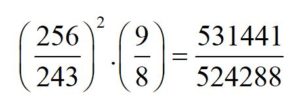
Philolaos calls the tiny difference a comma. Iamblichos’ further explanations of the comma are sheer nonsense and expose him as a mathematical philistine. Archytas of Taranto, another Pythagorean chronicler with outstanding mathematical skills, came to the conclusion much earlier that the exact division of the whole tone into two parts with a ratio of whole numbers is impossible. This is basically the same problem that we have already encountered with the division of the octave into two parts.
This insight is deadly poison for the Pythagorean doctrine, as it shakes it to its very foundations. The master teaches that everything is number and that everything can be represented as numerical relationships. However, a few simple considerations obviously show that the dogma cannot be true. It is possible that the shock of this realization was partly responsible for the downfall of the Pythagorean secret society.