
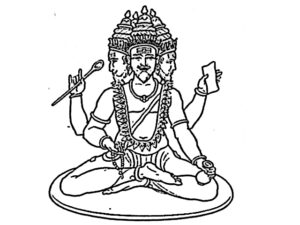
Myth of world creation
The greater area encompassing India, the Middle East, North Africa and Greece repeatedly produced remarkable poetic and philosophical works between 3000 BC and the time of the biblical apocalypse. They show a peculiar obsession with expressing quantities in exact numbers, even if there seems to be no poetic reason for this.
The obsession with numbers can already be found in Sumerian and Mesopotamian writings dating back to the third millennium BC. However, the even older early Indian Rigveda is the most detailed source. The poem – meaning: Hymn of Knowledge – is the oldest surviving text written in Sanskrit and was completed around 1000 BC. The earliest parts of the Rigveda were originally passed on in oral form and only later written down. The Rigveda is the oldest of the four books of Vedic literature and religion (the other three are called the Samaveda, the book of songs, the Yajurveda, the book of sacrificial sayings, and the Atharvaveda, the book of magic songs). The Vedas are the predecessors of the Brahmanas and Upanishads and are regarded as “divinely” inspired revelations, formulated by the holy seers (the Rishis) of ancient times.
The Rigveda creates a powerful myth of the creation of the world. Full of arithmetical and geometrical details, it describes how the universe emerges from a perpetual battle between the gods and demonic forces. The Vedic poets are fond of detail when it comes to specifying the exact number of rivers, steps that are taken, mountains that are created, sheep, sacred stones and even the ribs of a cosmic horse.
An example from the tenth book:
And man was a thousand-headed, a thousand-eyed, a thousand-footed, encompassing the earth on all sides, towering ten fingers high above it. All this was man: was that which has become and is yet to become, dominated immortality, that which continues to grow through nourishment.
As far as his greatness reached – man was even more powerful: one quarter makes up creation, three quarters are heavenly-eternal; for man ascended to three quarters; one quarter returns; from this he entered into everything, through food and directly.
The Radiant One came from him, but from the Radiant One came man. Born, he towered above all the ends of the earth. And when the gods sacrificed, when they offered man, spring was lard, summer firewood, autumn sacrificial food.
As a sacrifice on the litter they sprinkled man’s original birth as a sacrifice for themselves: the gods, seers and perfected ones. Consumed by this sacrifice and concentrated into a drop of lard, he created himself into a creature that lives in the air, in the forest, in the village. Consumed by this sacrifice, he came forth as verse and song and came forth as meter, brought himself to birth anew as a sacrificial saying.
And horses sprang from it, all the mammals, toothy, and cows calved, and sheep and goats came forth from it. When they cut man in pieces, how many parts did they divide? What was called his mouth, what his arms, thighs and feet? The high state of teaching was his mouth, his arm was made into the state of defense; his thigh became the state of multiplication, the state of nourishment sprang from his foot; the moon originated from his brain, in his eye the sun went to the mouth of Indra, Agni also, the wind came from the breath.
From his navel came the air, his head arched towards the sky; from his feet: land; from his ear: Wind rose from – thus they divided the world.
His rampart was sevenfold, they laid three times seven timbers upon it, the gods, when they offered it to man as a sacrificial animal. In sacrifice the gods offered him as the sacrifice – these were primal laws. Spiritually powerful, they drew the gods into heaven, where the perfected already lived.
Compare this passage with one from ancient Greek thought – Plato’s «State». There, too, clear arithmetical relationships prevail:
To the divinely begotten is set a circulation which the completed number determines for him, but for the mortally begotten that number in which, as the first number, roots and powers are multiplied, in three dimensions and four limits; equality and inequality, increase and decrease they create, and everything they make proportional and rational; their basic ratio three to four, married to the five, gives, thrice multiplied, two harmonies: one is of equal numbers, taken a hundred times as often; the other is square on the one hand, rectangular on the other; in one respect a hundred times the square of the rational diagonals of the five, but each diminished by one, the irrational ones by two, in the other respect a hundred cubes of the three. This, then, is the number, geometrically speaking, the mistress of good and bad births! If your guardians do not pay attention to her, marrying brides to men out of season, then the children will not be noble or blessed.
But that is not all, because in another monumental work of early Near Eastern cultures – as we shall see – similar tones are struck: in the biblical book of the Apocalypse:
All the arithmetic details in the Rigveda suggest that the whole text is a powerful metaphor of a certain mathematical structure. Based on connections to later Greek literature and the fact that cosmos, music and number theory are forged into a unity in Pythagoras’ philosophy, it can be hypothesized that the arithmetic system of the Rigveda is nothing other than a study of number theory, as suggested by the overtone series. This hypothesis has been pursued over many years by Ernest McClain, a musician working at Brooklyn College of the City University of New York, who believes that the Rigveda «represents a kind of protoscience of numbers and tones» and reflects an effort to find a practical solution to the incompatibilities between the overtone series and scale construction outlined above. The following presentation of the Rigveda is based on his findings. They are well-considered and, for the most part, understandable. Nevertheless, one should bear in mind that there is an inherent speculative element in many aspects.
Since, according to the Vedic view, the structures of the overtone series are reflected in the structure of the cosmos, one approaches the fundamental questions of epistemology. Music is able to connect abstract arithmetical facts with the world because certain numbers are distinguished or hierarchically structured in the overtone series in a way that they cannot be within a purely mathematical system. Even numbers are understood as feminine, odd numbers as masculine. Subsequently, the aim is to explain the system of musical (and, in the sense of the law of analogy, also cosmic) structures within a system of natural numbers that manages with the lowest possible values.
The central geometric motif of the Rigveda is the sun chariot, which embodies the year with its twelve months determined by the moon. The sun chariot has only a single wheel with twelve spokes. It is pulled by two horses. In long mythical explanations, the Rigveda explores the question of how this twelvefold division, which is reflected in the twelve-tone division of music, comes about.
Above all, a sexual metaphor is used here. God himself is the One who rests in himself and cannot create anything from himself. For further creation, he needs the female principle, the daughter and the mother. The number two is feminine and defines the maternal “matrix” within which everything else unfolds. But even she cannot create anything else from herself. Multiplied by itself, it merely spans the octave cycle:
or
1, 2, 4, 8, 16 . . .
In order to create diversity, the male odd numbers are needed, which are therefore closer to one than two and its multiples because of their oddness. Three is divine-masculine. It creates the spokes of the wheel, which correspond to the fifth (2:3) and the fourth (3:4) and come closest to the equal ideal of all subdivisions. The five is human-masculine. It creates the spokes that correspond to the major and minor thirds (4:5 and 5:6). The seven in turn plays the role of a boundary, as the previous numbers 1, 2, 3 and 5 can be used to represent all the notes of the chromatic scale.
McClain puts forward the hypothesis that the authors of the Rigeveda knew a certain way of organizing the tones of the scale, namely in tabular form in the form of a so-called «yantra» a rather complex thing.