
The model of music as a mirror of the world is the first abstract model of the world ever. It led to the discovery of general laws of numbers and was the impetus for the development of a powerful theory of numbers. The reason for this is probably that astronomical phenomena and music are the only things in the ancient world that seem to follow simple numerical ratios in a striking way: celestial bodies return periodically, years are divided into days, the moon waxes and wanes at regular intervals, strings produce harmonious sounds when divided in very simple ratios, and so on. Like no other areas of life, astronomy and music must have introduced prehistoric and early historical humans to numerical laws and abstract thinking.
Ancient humans must have noticed that a pleasant sound is composed of several components, whether they blew into flute-like instruments, accidentally touched vibrating strings at their nodes, or heard distinct overtones when producing musical tones in their own heads as a resonating body. In other words, they were confronted with the phenomenon of the overtone series, which probably amazed and puzzled them just as much as electricity, the relativity of space and time, or the success of the schmaltzy song «Gebet einer Jungfrau» («Prayer of a Virgin») did in later eras.
Understanding the mathematical and physical laws of the overtone series is basically simple. The only minor obstacle is understanding what is known as logarithmic hearing.
Physically, octaves are built up in an exponential manner:

From a physical point of view, the frequencies
of successive octaves are halves of those
of the preceding octaves.
However, the ear hears the layering linearly, C, C, C’, and so on, all seeming to be the same distance apart:

The ear hears octaves at a constant
distance from each other.
Actually, this is not entirely accurate either – in reality, the ear leaves the interpretation of distance more or less open. Much of our perception of distance is conditioned by cultural influences. As soon as we relate sounds to each other, we have the model of the piano keyboard in our mind’s eye, which precisely realizes the linear distance model:

On the piano keyboard, the notes appear to be arranged at
regular – linear – intervals.
The conflict between linear perception and exponential frequency response is responsible for the fact that auditory intuition repeatedly fails when it tries to understand the mathematical representation of the scale.
The true physical relationships between pitches cannot be read on a piano keyboard. The stretched string of a violin or guitar is much more suitable for this purpose: if you divide the string in the middle, you produce a tone that is one octave higher than that of the undivided string. If you divide the half string again – you get a quarter of the original string – you produce a tone that is again one octave higher, i.e. two octaves higher than the tone produced by the undivided string – entirely in accordance with the octave pattern described above.
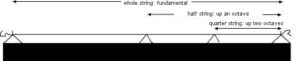
Continuing to halve a string results in
a tone that is one octave higher.
So much for octaves. But how are the other intervals produced? A fifth, for example, sounds when only two-thirds of a string is made to vibrate:

If a bridge is placed at two-thirds of the original string length,
the fifth of the original tone sounds
A fourth is the completion of the octave based on the fifth:
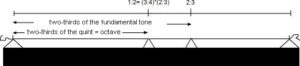
Two-thirds of a string produce the fifth of the fundamental tone.
The octave above sounds when three-quarters of the length of the fifth is measured. Mathematics confirms this: half is the same as three-quarters of two-thirds.
As you can see, 2/3 of the entire string produces the fifth, and 3/4 of this fifth produces the fourth, which completes the octave.
The upper octave, which is half of the lower octave, is therefore composed of a 2/3 and a 3/4 ratio. And because we want to add them together intuitively, based on our listening experience, we add the two numbers: 2/3 + 3/4. However, this is incorrect. As can be seen from the illustration, the octave is 3/4times the fifth, which is already 2/3times the lower octave. The correct calculation is:
Auditory impression: Fifth and fourth = octave
Mathematically: 2/3 times 3/4 = 1/2
The correctness of the mathematical formula can be verified by simple reduction. In general, intervals are superimposed by multiplying the ratios assigned to them.
An inversion of a ratio is a change of direction: 3/4 means a step up a fourth, while 4/3 means a step down a fourth (namely 4/3 of a string of the original note, i.e., a longer and therefore lower string).
There is another detail we need to clarify: you can experiment with the string by shortening it by placing a bridge underneath it or by dividing it with your finger, as with a guitar or violin string. Such a string produces different tones on both sides of the division:

If you place a bridge at two-thirds of a string that completely separates the two ratios, the fifth of the fundamental tone sounds on one side and
the octave of the fifth on the other (since one third is exactly half of two thirds).
However, you can also shorten a string using a technique known as flageolet. To do this, simply place your finger lightly on the string to create a vibration node. In this case, the same tone sounds on both sides of the division:

If, as with the flageolet technique, the string is touched only at the point of an integer division ratio, a vibration node is created.
In ancient times, the phenomenon of flageolet tones probably led to the discovery of interval ratios, and not, as is often claimed, the ratios of the strings of the lyre to each other. When tuning two strings, factors such as string tension and composition also play a decisive role. The strings of a guitar are all the same length, yet they produce different tones.
This clears the biggest hurdles to understanding. The physical properties of the overtone series and the tone scales can now be easily explained.
The first question is what ratios the intervals have to each other. This seems clear in the case of the octave: two tones in a ratio of 1:2 produce an octave. This also seems simple in the case of the fifth (2:3) and the fourth (3:4). For finer subdivisions, we can consult the overtone series:
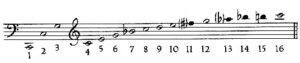
The overtone series; the black tones do not
fit neatly into a scale construction.
For the whole tone, we have a whole series of possible numerical ratios between B flat and E: 7:8, 8:9, 9:10, 10:11. What criteria should we use to choose? It becomes even more confusing when we want to define a semitone interval: Do we choose F sharp-G (11:12), or G-A flat (12:13), or even the even finer 13:14, 14:15 or 15:16?
It may help us to remember that two semitones must make a whole tone. There is a good reason to choose the whole tone as a ratio of 8:9. In this case, according to our method of stacking tones on top of each other, a fourth and a whole tone result in exactly what they should: a fifth:
3/4 * 8/9 = 2/3
If you want to find the correct ratio for a semitone and define the whole tone as 8:9, then you need to choose a ratio for which the equation
a/b * a/b = 8/9
. There is no solution for this from the selection 11:12 to 15:16. There is no rational ratio for this at all. Actually, there is only one solution: Instead of 8:9, we choose the ratio 7:8 for the whole tone and grudgingly accept two unequal semitones, namely 14:15 and 15:16. The equation is then
14/15 * 15/16 = 7/8
However, this means that the structure of the fifth consisting of a fourth and a whole tone no longer works, because the equation
3/4 * 7/8 = 2/3
is incorrect.
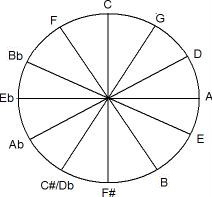
A second method of producing all the notes of the scale also leads to a dead end. The well-known circle of fifths. In this method, octaves and fifths are stacked on top of each other until they collapse again:

(octave and fifth stacking): The fifths fall in a sequence of octaves to the
notes G, d, a, e’, h’, f#” and so on until f””’ and c””’ – or almost; the two
natural ways of constructing a circle do not quite coincide.
The problem is that the two layers will never meet, as a simple series of tests proves. The octave stacking is represented as
1/2 * 1/2 * 1/2 *…. * 1/2 = (1/2)n
The fifth stacking, however, has the following form:
2/3 * 2/3 * 2/3 * …. * 2/3 = (2/3)n
However, elementary number theory shows that there can be no numbers m and n such that
(1/2)n = (2/3)n
because 2 and 3 are relatively prime.
However, (1/2)7 and (1/3)12 are so close that they can be equated with a little cheating. With a good argument: if whole tones and semitones cannot be defined exactly, then one can also allow oneself this. Moreover, it corresponds to the behavior of the circle of fifths if the octave were divided exactly into twelve semitones.
Now another problem arises: the exact halving of the octave. Like the exact halving of the whole tone, this is something that lies outside the numerical ratios that can be represented as fractions of two natural numbers. What we are looking for is a ratio such that
x * x = 1/2
i.e., two identical tones stacked on top of each other result in exactly one octave. The mathematical solution is not a rational number:
x = 1/√2
The realization that the exact halving of the octave cannot be represented rationally led to very different conclusions in India than in Greece. The inhabitants of Hellas insisted on giving preference to rationality and proclaiming a single, indivisible truth – even at the cost of denying practical experience. The authors of the Indian Vedas took these findings as the starting point for a pluralistic worldview: if there can be no single valid theory, then the different practical worldviews should be given equal status – according to the motto “live and let live.”
One way of constructing a satisfactory scale from the existing material looks something like this:
C 15/16 d 8/9 e 9/10 f 8/9 g 15/16 a 8/9 h 9/10 c
If you want to express the ratios in natural numbers as subdivisions of the ratio 1:2, i.e. the octave, which is more in line with ancient arithmetic, then you have to find natural numbers such that their ratios correspond to those given. To do this, we extend the above sequence so that instead of fractions, natural numbers are in ratio to each other. The smallest possible integers that satisfy this condition are:
30 32 36 40 45 48 54 60
These are all numbers that are smaller than 60 and can be expressed in the form 2p3q5r. Assuming that the octave represents the closing of a circle, a moment from which everything repeats itself, these tone ratios can also be represented as a circle: