
Krumhansl’s cognitive foundations
The cognitive aspects of music perception are more difficult to access in scientific experiments than the neurophysiological aspects, primarily for two reasons: Firstly, cognitive phenomena cannot be observed directly. The experimenter is dependent on the subject’s information; however, many possible confounding factors come into play here, such as the subject’s linguistic competence and reliability or the fact that it is not possible to decide whether a subject actually has a questionable perception or merely believes to have it. On the other hand, cognitive structures cannot be measured precisely. They are generally limited to qualitative characteristics. For example, everyone who is not completely unmusical agrees that scales go up and down. It is difficult to decide exactly how much larger the step from d to c is than that from g to a flat, as well as which scale is used – this is already Viktor Zuckerkandl’s insight.
The question of measurability also touches on very fundamental issues, above all because measurements permit extremely precise statements, but the mind tends to move in a universe of vagueness and approximations.
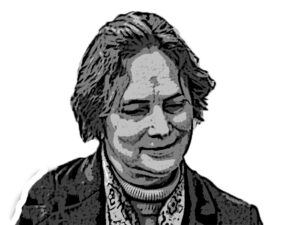
Nevertheless, efforts have been made to quantify the phenomena of musical perception. The music psychologist Carol Krumhansl, who works at Cornell University north of New York, has an outstanding position in this regard. She can be seen as the experimental psychologist counterpart to music theorist Fred Lerdahl. The two like to refer to each other and arrive at similar theoretical and practical results.
With «Cognitive Foundations of Musical Pitch», Krumhansl has written a standard work of cognitive music psychology. The main focus of the book is to experimentally test and quantify the hierarchical structures between tones and chords, as developed by Lerdahl and Jackendoff in GTTM. The basic experimental procedure was devised by the psychologist together with her colleague Robert N. Shepard back in the 1970s.
Broadly speaking, the experiment proceeds as follows: A tone sequence is played to a test subject, followed by another tone. The subject is then asked to use a scale to indicate the extent to which the subsequent tone completes the preceding tone sequence. For example, if you play a D major scale from D to C sharp and the following note is D’, the rating will be visibly higher than if you add an A flat after the D major scale up to C sharp.
Krumhansl uses statistical methods to compensate for the lack of precision and consistency in the assessments: Numerous evaluations are condensed into an average value or correlated with each other. In this way, the psychologist obtains a structure of the tonal space that largely corresponds to that in «Tonal Pitch Space» by Fred Lerdahl.
Krumhansl states that the human mind not only registers frequency, amplitude, duration and timbre, but also superimposes further structures on sensory perceptions and stores sounds in memory in a way that does not correspond to the storage of pure sensory impressions. Each new sound is subsequently measured against these structures or fitted into them: «The experiments show that people’s musical capacity lies in their ability to dynamically relate sound events to each other and to understand the variety of structural functions of the events on numerous levels simultaneously,» she summarizes her insights.
Krumhansl’s experiments and the conclusions drawn from them can be seen as a powerful and obvious refutation of the behaviorist approach. What is self-evident to every musician and also caused Carl Seashore to distance himself critically from behaviorist teaching is precisely formulated here in the language of the «positivist» natural sciences.
Incidentally, Krumhansl conflicts with Jackendoff’s conception when she adds that at no point is a single or correct analysis of structures required in order to understand music. As we have seen, however, such an analysis is a prerequisite for the kind of parsing strategies that Jackendoff emphasizes in the article «Musical Parsing and Musical Affect».
Another result of the experiments is that there appears to be a close relationship between the frequency with which a sound is heard and its position in the cognitive hierarchy. This could support the view that the human mind deduces the hierarchy of tones from statistical distribution patterns. An assumption that Leonard B. Meyer had already made before Krumhansl.
Krumhansl has not only done valuable work in the experimental field. She also took a closer look at the structure of tonal organization from a theoretical point of view and discovered some extremely interesting properties of our scale system.
The major scale is known to follow the pattern whole tone, whole tone, semitone, whole tone, whole tone, whole tone, semitone. If you count all the intervals that occur between any two notes, you get the following list:
2 minor seconds (or major sevenths)
5 major seconds (or minor sevenths)
4 minor thirds (or major sixths)
3 major thirds (or minor sixths)
6 fourths (or fifths)
1 tritone
This distribution can be written as a vector as follows: <2,5,4,3,6,1>.
The vector has some interesting properties that you only really become aware of when you look at it through the eyes of a statistician. For example, the least dissonant intervals occur most frequently, while the two most dissonant intervals are the rarest. In addition, each entry in the vector is unique, i.e. there are no two different intervals that occur equally frequently. In addition, each interval occurs at least once. But that’s not all. The arrangement of the intervals makes it possible to recursively generate the entire cycle of the twelve keys by raising a step near the middle of the scale by a semitone.
There is a small surprise when you try to find another scale that has a comparable richness and balance. If you require that all intervals within an octave range occur at least once in a scale and that each entry is unique, you will find that the scale must have exactly seven steps. If there are fewer, one interval type will be missing; if there are more, at least two interval types will occur with equal frequency. A similarly ideal situation applies to chords that can be formed on the basis of the scale. Our major scale is therefore a kind of optimum in terms of the statistical distribution of important characteristics, an ideal model that has developed unconsciously over the centuries of music-making.
However, we must be careful not to see this as proof of the naturalness or God-given nature of tonal music. The characteristics do not suggest that the most beautiful and «natural» music can be written with the major tonal key. They merely show that hierarchical structures can best be constructed with the help of major/minor tonality. However, composers have developed many other, equally «natural» architectural principles that have produced music that is no less interesting and moving.