Johannes Kepler’s world harmony
The work of the astronomer and mathematician Johannes Kepler (1571 – 1630), who was active in Germany at around the same time as the polyphony critic Vincenzo Galilei in Italy, represents a quantum leap in the history of the harmony of the spheres. In fact, there are points of contact between the two: Kepler was the first to accept Vincenzo’s son Galileo’s observation of the moon’s valleys and mountains and introduced his observation methods to the north with the help of a telescope.
Two things are decisive for Kepler’s work: on the one hand, he is methodologically a child of modern times, i.e. instead of simply accepting the results of the ancients in the form of uncritical paternalism, as the medieval thinkers did, he focuses on the concrete verification of the claimed facts. On the other hand, for the first time since antiquity, he was able to draw on spectacular new data. He can take it from the Danish astronomer Tycho Brahe (1546-1601), who spent most of his time in the two observatories Sterneborg and Uraniaborg on the island of Sven in the Sound over thousands of nights. The stubborn and opinionated Brahe fell out with the Danish king and fled to Prague, where he met Kepler. He had developed a world view – similar to that of Eriugena – according to which the planets revolved around the sun. The planets and the sun in turn revolved around the earth, which was still the center of the universe.
Brahe hoped that Kepler would confirm his theory with further calculations, but Kepler refused. As a result of this refusal, Kepler only came into possession of the Danish material when he succeeded Brahe as imperial mathematician after Brahe’s death. It is said that Brahe’s descendants did not really want to hand over the data because they were hoping for money, and that Kepler «acquired» it in a way that would probably have made him look old in court.
Brahe, a brilliant observer, dealt the idea of the literal «harmony of the spheres» its first serious blow. Up until his time, it was still believed that the planets were actually carried by physically existing spheres moving in the sky. Such a construction also gives the idea of celestial music a certain plausibility. However, Brahe then observes a comet and concludes from his observational data that it must cross the orbits of the planets in sequence. This means, however, that there can be no spheres in the sky. Such spheres would represent an insurmountable obstacle for a comet, or the breaking through of the shells would have to be observable in some form. The comet would have to break too much cosmic crockery, so to speak, to go unnoticed.
Like many others, Kepler’s life was very eventful at a time of great religious battles and epidemics. After an education in Stuttgart and Tübingen and a period as a mathematics teacher in Graz, he first publishes the «Mysterium cosmographicum», the «Mystery of the World», in which he attempts to fit the so-called regular bodies into the planetary orbits. After Brahe’s death in 1601, he became a royal mathematician in Prague, as mentioned above. In 1609, a work was published that was to have a profound influence on the idea of the harmony of the spheres: «The New Astronomy», in which Kepler explains that the planets do not move in concentric circles and at regular speed, as previously assumed, but in ellipses and at varying speeds.
At the Imperial Diet of Regensburg, Kepler exposed himself by taking up the catholic Gregorian calendar, which was rejected by the Protestants more out of religious defiance than on the basis of real arguments. In 1619, his «Weltharmonik» was published and the Protestant-Lutheran church excluded him from the Lord’s Supper because he advocated the Copernican world view, according to which the sun was at the center of the earth. Two years before the outbreak of the Thirty Years’ War, his mother was also accused of witchcraft. Only at the last moment does he manage to free her from prison and save her from the stake. After being expelled for religious reasons, he enters the service of the general Wallenstein, for whom he draws up several horoscopes. In the end, however, he warned him against believing in astrology. He refuses to complete another horoscope.
Kepler’s work on the harmony of the spheres is clearly divided into two periods. In his early work «Mysterium cosomographicum», he presupposes the Copernican world view with concentric planetary orbits around a sun at the center. To this end, he sought a connection with the five regular solids of geometry. The failure of the project led him to discover the elliptical shape of the planetary orbits.
First of all, the «Mysterium cosmographicum»: The five regular solids, also known as «polyhedra», have been known since Plato’s time: They are all possible regular solids that fulfill the following condition: They can be formed with faces that have regular sides. As you can easily see, only the equilateral triangle, the square and the regular pentagon come into question. Three solids can be formed with the equilateral triangle, one each with squares and pentagons:
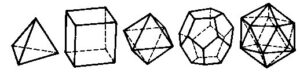 The five regular solids tetrahedron, cube, octahedron, dodecahedron and icosahedron
Plato composed the elements of the world structure from the regular surfaces. Earth consists of squares that form cubes and therefore cannot mix with other elements. Fire, air and water, on the other hand, all consist of equilateral triangles in different arrangements: as a tetrahedron they become fire, as an octahedron they become air and as an icosahedron they become water. This means that two parts fire make one part air, as two four-sided triangles can be formed from one eight-sided triangle. Similarly, five parts air make two parts water. Unfortunately, one regular body remains in the ingenious system, namely the dodecahedron. Plato somewhat arbitrarily assigns it the function of the whole of the world, which smells strongly of a category mistake.
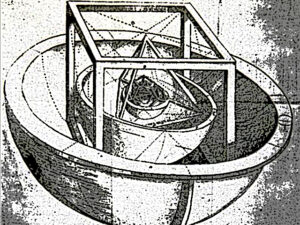
In the 17th century, the six planets Mercury, Venus, Earth, Mars, Jupiter and Saturn were known, which gave Kepler the idea of fitting the five polyhedra between them. This was supposed to be proof that the number of planets was necessarily six and that God had created a perfect world. Kepler tries to nest the polyhedra inside each other in such a way that the spheres circumscribing each coincide with a planetary orbit:
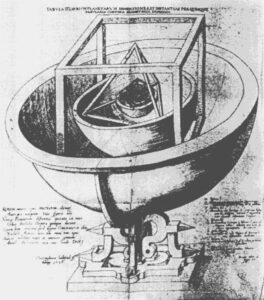 The polyhedron model from Kepler’s
«Mysterium cosmographicum».
The polyhedron model from Kepler’s
«Mysterium cosmographicum».
The Earth’s orbit, which is the «measure of all things», is circumscribed by the dodecahedron. The circle circumscribed by the dodecahedron is the orbit of Mars. This in turn is circumscribed by the tetrahedron. Once the construction is complete, the following bodies rest inside each other from the inside out: Mercury – Octahedron – Venus – Icosahedron – Earth – Dodecahedron – Mars – Tetrahedron – Jupiter – Cube – Saturn.
In a concluding hymn, the emphatic Kepler praises the work of God:
… but I seek the trace of your spirit outside in the universe,
behold with rapture the splendor of the mighty celestial edifice,
this artful work, your omnipotent marvels.
See how you have set the orbits according to a fivefold standard,
in the midst of it, to give life and light, the sun.
See by what law it regulates the orbit of the stars,
how the moon performs its rotation, what work it does,
how you scatter millions of stars across the heavenly realms.
However, the construction does not really work out – especially not when the planetary orbits have to be fitted exactly. In «World Harmony», Kepler admits in old age that he was wrong to a certain extent in the construction of the polyhedron model:
There is, however, not perfect equality, as I had once boldly believed that a perfect astronomy would be able to prove (…) From this it is clear that the ratios of the planetary intervals from the sun are not exactly taken from the regular bodies alone. For the Creator, the actual original source of geometry, who, as Plato says, drives eternal geometry, does not deviate from the archetype. The same could have been concluded from the fact that all planets change their intervals in periodic time periods, in such a way that each has two distinct intervals from the sun, one largest and one smallest.
Kepler’s last remark refers to the different distances of the planets from the sun, which is due to the fact that they do not move in a circular orbit. Such an orbit is characterized by the fact that the distance of any point on the circle to the center of the circle is always the same. However, Kepler’s discovery of the variation in distance was not least due to the inconsistencies he encountered while working on the «Mysterium cosmographicum».
According to what is now known as Kepler’s first law, the path around the sun runs along an ellipse with the sun at one of its focal points. The planets pass through two special points: the one at which they come closest to the sun – called «perihelion» – and the one at which they are furthest away from the sun – called «aphelion»:
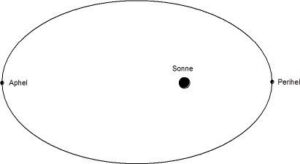 The planets do not move in a circle,
but on an ellipse around the sun, which is located in one of the focal points of the ellipse.
The planets do not move in a circle,
but on an ellipse around the sun, which is located in one of the focal points of the ellipse.The distances therefore fluctuate constantly, and the planets would actually produce something in relation to the orbit around the sun that would correspond to a musical glissando. Another of Kepler’s insights is that the speed of the planets on the elliptical orbits is not always the same. The closer they move from aphelion to perihelion, the faster they become, and the further they move from perihelion towards aphelion, the slower they become.
In order to avoid all these fluctuations, Kepler searched in the «Harmonices mundi libri V» of the «World Harmonics» for conditions that were independent of the sun/planet distance. After a long, laborious search, he finally came across one that seemed to suit his purposes. It is as follows: If an observer were sitting on the sun and observing the course of a planet from aphelion or perihelion for twenty-four hours, he would be able to see an angle between the first and second viewing directions. These angles are called the apparent diurnal arc at aphelion and perihelion respectively.
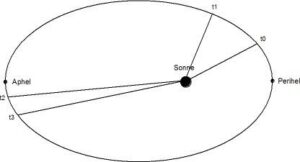 Kepler’s third law: If a planet
needs the same time for the distance t0-t1
as for the distance t2-t3, then the two areas
spanned have the same content.
Kepler’s third law: If a planet
needs the same time for the distance t0-t1
as for the distance t2-t3, then the two areas
spanned have the same content.Kepler now finds his long-sought harmony in these values. On the one hand in the apparent diurnal arcs of aphelion and perihelion within a planet, and on the other hand between those of neighboring planets.
For the following tables, we assign the following letters to the aphelion/perihelion daily arc values of the planets according to Kepler:
| Saturn |
Aphelion |
a |
|
Perihelion |
b |
| Jupiter |
Aphelion |
c |
|
Perihelion |
d |
| Mars |
Aphelion |
e |
|
Perihelion |
f |
| Earth |
Aphelion |
g |
|
Perihelion |
h |
| Venus |
Aphelion |
i |
|
Perihelion |
k |
| Mercury |
Aphelion |
l |
|
Perihelion |
m |
Kepler’s table looks as follows for the aphelion/perihelion ratios of a single planet in itself:
| a:b = 4:5 |
maior third |
c |
e |
|
|
|
|
| c:d = 5:6 |
minor third |
|
e |
g |
|
|
|
| e:f = 2:3 |
quint |
c |
|
g |
|
|
|
| g:h = 15:16 |
minor second |
|
|
|
|
b |
c’ |
| i:k = 24:25 |
diesis |
|
|
g |
g sharp |
|
|
| l:m = 5:12 |
minor decime |
|
e |
g |
|
|
|
Quite complicated for simple basic laws…
However, the values are not as clean as the idealized table looks, which Kepler also admits:
Thus Saturn and Jupiter comprise a little more than a major and minor third; the excess for the former is 53/54, for the latter 54/55 or a little less, i.e. about one and a half decimal points. Earth forms a little more than a semitone; the excess here is 137/138, i.e. barely half a comma. Mars is less than a fifth by a considerable amount (i.e. 29/30, a value approaching 34/35 or 35/36). Mercury reaches a minor third rather than a whole tone above an octave; the distance from that is about 38/39, which is about two commas in the amount of 34/35 or 35/36 together. Only Venus shows a proportion that is smaller than all melodic intervals, even than a Diesis; it lies between two and three commas and exceeds 2/3 of a Diesis, being approximately equal to 34/35 or 35/36, i.e. a Diesis reduced by one comma.
In addition, there are ratios between planets, namely the aphelion/perihelion ratios of neighboring planets:
| a:d = 1:3 |
duodecime |
|
|
|
|
|
|
| b:c = 1:2 |
octave |
|
|
|
|
|
|
| c:f = 1:8 |
three octaves |
|
|
|
|
|
|
| d:e = 5:24 |
minor third + two octaves |
|
|
|
|
|
|
| e:h = 5:12 |
minor third + octave |
|
e |
g |
|
|
|
| f:g = 2:3 |
quint |
c |
|
g |
|
|
|
| g:k = 3:5 |
major sixth |
|
e |
g |
|
|
|
| h:i = 5:8 |
minor sixth |
|
e |
|
|
|
c’ |
| i:m = 1:4 |
two octaves |
C |
|
|
|
|
c’ |
| k:l = 3:5 |
major sixth |
|
e |
g |
|
|
|
The aphelion/perihelion ratios of individual planets have a special feature: a single planet cannot be in its aphelion and perihelion at the same time. Neighboring planets, on the other hand, can. However, the actual positions are only assumed at a very specific moment. Otherwise, the positions of the planets in relation to each other are constantly changing. The interval ratio between Earth and Venus, for example, fluctuates between major and minor sixths. Kepler – very much a child of his time – relates this constant fluctuation to the polyphony of church music:
Just as simple or monophonic singing, which is called choral singing and was known only to the ancients, relates to polyphonic, so-called figured singing, which is an invention of the last few centuries, so too do the harmonies formed by the individual planets relate to the harmonies of the pairs of planets. For this reason, the individual planets are compared with the choral music of the ancients and their special features are shown in the planetary movements.
To a certain extent, the «harmony of the spheres» has found its offshoots to this day – which shows that ideas can persist even when they have actually long outlived their usefulness and have lost all basis in their original motivation. A small renaissance of the Pythagorean-Keplerian tradition was initiated in 1889 by the German scholar Albert von Thimus with his work «Die harmonikale Symbolik des Alterthums». However, his interest remained predominantly philological. However, the attempt to reconstruct ancient Pythagoreanism gave rise to further research by Hans Kayser (1891 – 1964). The polymath, who trained as a musician, scientist and philosopher in Berlin and at the University of Erlangen, settled in Bern, Switzerland, in 1933. His further development of Pythagoreanism is characterized on the one hand by philological work on mystical literature and his origins as the son of a pharmacist. The latter led him to apply many «harmonic laws» to botanical phenomena. His work was in turn continued by the musicologist Rudolf Haase, born in 1920, who founded the «Hans-Kayser-Institut für harmonikale Grundlagenforschung» at the Vienna University of Music. Not least thanks to Haase’s efforts, «basic harmonic research» is still taught at the University of Music and Performing Arts Vienna today (2003).
The course is run by Werner Schulze and has resulted in a number of harmonically inspired compositions by contemporary composers. The idea still has many followers in anthroposophical circles.
However, many scientists of later eras, above all the physicist Hermann von Helmholtz, had nothing but derision for «world harmony», even if they recognized Kepler’s great scientific achievements in astronomy. They were rather surprised that a mind as brilliant and critical as Kepler’s could be preoccupied with the false magic of astrology and the secret sciences. What they overlook is the fact that Kepler approached the problem of the analogy between the microcosm and the macrocosm with the same scientific spirit as all other scientific tasks and that one of his great achievements was to show that the theory of the sounds of the spheres, as it has been handed down since antiquity, is not tenable. After all, his search for an alternative formulation led him to the third planetary law.