Hanslick skeptically dismissed all attempts to see music as a language of emotions. However, this did not prevent later generations from embarking on a similar project.
The best-known attempt was made by the English musicologist Deryck Cooke, who died in 1976 and, like Hanslick, made a name for himself as a music critic. He also wrote the performance score for Gustav Mahler’s 10th Symphony. His classic work is unambiguously titled «The Language of Music» (1959), and the title page plays with the theme by proclaiming a motto in musical form next to the title, author, and publisher
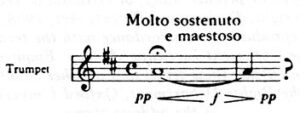
The motto of Cooke’s «The Language of Music»
The idea is amusing. Ironically, however, it anticipates the failure of the theory of a musical language. For one is unable to understand the punchline. In fact, the quotation is the beginning of Richard Wagner’s Rienzi overture, which Cooke describes in the following text of the book as «beautiful, mysterious, and gripping.» The sound, he says, arouses a sense of awe and curiosity and evokes a subtle anticipation of the heroic things to come.
The small flaw lies in the fact that the punchline has to be explained, which means that the joke is no longer funny. The unintended and actually funny irony lies in the concealed claim to have written a heroic book, when in fact it is merely an attempt at a failed enterprise.
In his book, Cooke asserts precisely what Hanslick so vehemently denies: that music is indeed a language of emotions and that its syntactic building blocks, its rhythms, sounds, and intervals, have emotional meanings that are valid across all times and styles, meanings that can, to a certain extent, be explained by biological facts.
Cooke builds his system on a few basic elements: at the lowest level are interval tensions, which are supposed to have fixed roles in emotional communication to a certain extent. These are influenced by framework conditions set by the parameters of volume, tempo, pitch, timbre, and texture. From these basic elements, short phrases can be derived as the actual expressions of musical language, such as an arpeggiated triad or scale fragments, which also have more or less stable emotional meanings—regardless of their rhythmic form. In a composition, the phrase only acquires its rhythmic character through creative imagination, which shapes it into a specific statement in a specific composition.
Cooke wonders how it is possible for an extensive piece of music to function as an expressive whole. Following the Anglo-Saxon tradition of John Locke, David Hume, and associationism, he imagines the process roughly as follows:
- The memory of countless uses of interval tensions means that these are linked into groups through the association of ideas; these groups, in turn, are linked to concrete life and sensory experiences.
- The groups contain subgroups that encompass a specific use of an interval tension, i.e., one of the basic elements.
- The same process also applies to keys, giving rise to associations between keys and certain expressive qualities (e.g., C minor as a «tragic» key).
Based on this concept, Cooke defines inspiration as the spontaneous combination of individual basic elements into a specific form.
Cooke also outlines an example of how this process works in practice: imagine a composer who has to write an opera based on Hamlet. The opening scene of Shakespeare’s play is dominated by a nocturnal atmosphere of coldness, unrest and foreboding. The composer therefore reviews all the memories of basic elements that evoke such moods in his mind’s ear. The basic elements, such as the «anxious little sixth» or the «tragic little third,» are imagined in short phrases, for example the sequence of notes fifth – root – minor third with its «heroic» overtones, which are then given a rhythmic character and thus become a basic motif for the scene.
In order to understand Cooke’s argument, it is worth considering the individual steps of a possible musical communication in detail. The composer wraps an emotional message in a piece of music. The listener hears the music and distills the message from it. However, this leaves a few questions unanswered, most notably whether the composer is saying something about his own feelings and whether the listener is merely presented with an undefined emotional content (as Hanslick claims), or whether this is the specific emotional state that the composer wanted to communicate. A corresponding diagram might look something like this:
| Composer | Music | Listener | |
| weak theory (Hanslick) | forms musical structures | is expressive | perceives music as expressive |
| strong theory (Cooke) | has a specific emotion | expresses the specific emotion | hears the specific emotion in the composition |
The weak theory merely asserts that music is expressive and that it touches the listener emotionally. According to the weak theory, of which Hanslick could be considered a representative, the composer merely forms abstract structures. There is no concretely determinable relationship between what the listener hears in the music and what the composer has consciously or unconsciously put into it in terms of emotional expression.
According to the strong theory, as represented by Cooke, the composer uses music as a means of expression for a concrete state of mind, which can also be understood by the listener as intended by the composer. Cooke even takes the radical—and therefore dangerous—view that listeners who hear something different in music than what is contained in it are mistaken, whether due to a lack of sensitivity or a lack of practice. Why this position is very dangerous will be explained in more detail below; first, let us examine the arguments for the individual steps that Cooke takes.
Let us turn to the first assertion of the strong theory. It states that the composer expresses his own concrete feelings in music. Cooke attempts to support this assertion with an analysis of the emotional content of Beethoven’s Third Symphony.
First, he explains, Beethoven was enthusiastic about the ideas of the French Revolution. He even originally intended to dedicate the work to Napoleon. We know from various sources that Beethoven was completely imbued with the revolutionary idea of freedom and that he conceived the symphony as an expression of this strong feeling. According to Cooke, this is concretely reflected in the themes of the work. He illustrates this with the funeral march:
One of the feelings aroused in Beethoven by the heroic idea of freedom was, as we know, a deep concern about the fate that awaited many, and especially many liberators – that of being completely crushed. He must therefore have felt compelled to express this feeling in his symphony in the appropriate place: the slow movement was to be a funeral march. The laws of tonal language now demanded a slow march tempo in a minor key (C minor was the «tragic» key of Beethoven’s great predecessor Mozart) and a mournful theme for a funeral march. It is ridiculous to imagine that Beethoven consciously called all these requirements to mind one after the other; they must have crystallized completely unconsciously in the C minor theme, around the classical tragic formula of the minor triad. Beethoven’s unconscious mind adapted his own feelings about the death of a hero to the clichés of the music of his time – but in his own personal way.
We can already hear Hanslick exclaiming: «Mourning, yes, but not mourning for the death of a hero!» And of course we have to agree with Hanslick. Nevertheless, let’s take a closer look.
On the one hand, there is the inadmissible circular argument: Cooke uses the example to prove his thesis that the composer encodes his own concrete feelings in the music. This, in turn, is the prerequisite for claiming that the listener understands what the composer wants to communicate emotionally. However, he presupposes this understanding, which first needs to be proven, when he claims to be able to interpret the theme in exactly this way. It actually makes sense that we can only say whether a composer is capable of expressing a specific feeling in music once we are able to understand it, because only then can we really verify the claim. The argument is therefore, for the time being, a futile exercise.
But let us assume that the second thesis has already been proven. Hanslick’s objection then remains. That Beethoven packed his own feelings about the death of a hero into the theme is pure speculation that cannot be read from the expressiveness of the theme. Even if it were true and could be corroborated by Beethoven’s sworn statements («I swear that when I wrote the theme, I had the grief over the death of a hero as my model»), this does not mean that he succeeded in doing so. Good intentions are not enough. The question of whether Beethoven might have intended the funeral march as a tribute to a dead hero is not decisive.
Admittedly, there are good reasons for such an assumption. A funeral march as the basis for the slow movement in a sonata form was highly unusual in Beethoven’s time, and the slow movement of the Piano Sonata Op. 26, written at around the same time, is even entitled «Marcia funebre sulla morte d’un Eroe» (Funeral march on the death of a hero). The theme therefore really does suggest itself. But even if Beethoven had titled the second movement of the Eroica «Marcia funebre sulla morte d’un Eroe», it would still not be certain that the theme actually expresses sorrow or grief. There is even some evidence to the contrary. The movement is formally quite bold, with a contrasting trio in C major, an expressive fugato, and a reprise of the theme with an underlying off-beat rhythm that gives it something ironic or bizarre. As a «homage to a dead hero,» the piece would undoubtedly be too frivolous.
No, Hanslick is right. The melody is solemn, oppressive and dull. The fact that this is the oppression and dullness of mourning for a dead hero cannot be heard in the music. One can assume that Beethoven had something like this in mind, but this is based solely on extra-musical evidence and is irrelevant to the musical understanding of the piece.
One could just as easily imagine that the second movement depicts the scene of a foggy dawn in a field where a decisive battle is about to be fought. Then one suddenly hears an underlying tremulous tension that leads to a triumphant victory. An equally plausible interpretation could be the idea of suppressed anger over a personal defeat, which erupts in accusatory self-doubt, and so on and so forth.
The strong theory of musical expressiveness therefore stands or falls on the ability to prove the second thesis, namely that the listener is able to hear a concrete feeling in the music («the grief over the death of a hero»).
What arguments does Cooke put forward in support of this?
His defense of the weak theory can be safely skipped, as we do not dispute it. As we have already hinted, he has the following to say about the strong theory:
Could it not be that some listeners are simply incapable of adequately understanding the feelings expressed in music? This may even be the case in literature: I have seen Edmund in King Lear portrayed as a cynical butterfly, and the audience reacted accordingly with giggles. (…) The fact is that people can only respond to feelings expressed in art that they themselves are capable of feeling. (…) The truly musical person with a normal ability to respond to feelings understands the emotional content of a piece of music to the extent that he can experience it himself.
The argument has something of a sleight of hand about it. For, as in the first case, it presupposes what it is supposed to prove. For someone to be able to misunderstand something, it must already have been proven that there can be a correct interpretation, i.e., it must be presupposed what one wants to prove: that one can understand the emotional content of music «correctly.» Furthermore, Cooke wants to prove that it is possible to express concrete, differentiated feelings. However, he only cites seemingly obvious misjudgments as criteria for a correct understanding of emotional content, such as that the funeral march from the Eroica is a kind of bizarre scherzo.
The counterexample is unfortunate because it confuses two completely different criteria: the recognition of a conventional musical form (scherzo) and a general emotional characteristic. As already mentioned, there are some good arguments to be made for the claim that the funeral march from the Eroica is bizarre.
In other words, Cooke has changed the subject in several respects without even attempting to prove his initial thesis.
And why?
Because there is no such proof.
At the beginning of the second chapter, Cooke makes it unmistakably clear that he wants to present something like a dictionary of musical language: «The task we face is to answer the question of how exactly music functions as a language, to define the expressions of its vocabulary, and to explain how one can legitimately say that these expressions give expression to the feelings they seem to convey.» He is indeed serious about vocabulary.
His summary of the basic expressive functions of the twelve tones of the scale is as follows:
| Tonic | Emotionally neutral, context of completion |
| Minor second | Half-step tension down to the tonic. In a minor context: powerless anxiety, context of conclusion |
| Major second | Emotionally neutral as a passing tone, pleasant longing as a whole tone tension down to the tonic in a major context, context of conclusion. |
| Minor third | Harmony, but a suppression of the natural third, stoic resignation, tragedy. |
| Major third | Harmony, natural third: joy |
| Fourth | Emotionally neutral as a passing note, dramatic as a semitone tension down to the major third |
| Tritone | As a modulating note in the dominant key, active longing. As an augmented fourth, pure, simple, devilish and hostile force |
| Dominant | Emotionally neutral, context of flowing, being in between. |
| Minor sixth | Half-step tension downward to the dominant. In a minor context, active anxiety in a context of flowing. |
| Major sixth | Emotionally neutral as a passing note, as a whole-tone tension down to the dominant in a major context, pleasant longing in a flowing context. |
| Minor seventh | Half-step tension downward to the major sixth or whole-tone tension downward to the minor sixth, both unsatisfactory, further resolution downward to the dominant: «lost» note, tinged with sadness |
| Major seventh | Emotionally neutral as a passing note, aggressive longing as a semitone tension upward to the tonic, longing in a context of conclusion |
One could forgive him for committing a category error in his list – he describes most intervals by their absolute distance and primas and fifths by their functions in Riemann’s functional harmony. In fact, however, his arguments in developing the table are full of such jumping back and forth between the most diverse functions of an interval. This is particularly true in relation to its absolute position in the scale on the one hand, and as an absolute interval value on the other.
This criticism can be illustrated with an example, the discussion of thirds. According to Cooke, the major third established itself as a symbol of joy and happiness in the early modern period, when it introduced the «human» element of the third into sacred music composed of octaves, fifths, and fourths. The minor third was then quickly understood as an altered major third, introducing a mournful character into music. However, Cooke relativizes the assignment of major = happy and minor = sad by pointing to counterexamples, such as Mahler’s funeral march from Saul and his Song of the Earth (both sad, but in major) and Bach’s «Badinerie» from Suite No. 2 (happy, lively in minor). On the other hand, he cites a wealth of examples that show that the major and minor thirds were used to express cheerful and sad emotions respectively.
Cooke cites another reason for the specific expression of thirds: in a triad, both have the function of providing closure at the beginning, middle or end of a piece. Unlike the other notes in the scale (except, of course, the fifth and octave), they do not need to be resolved – as long as they «retain their character as part of the triad.» The third therefore has a settled character, pleasant in the major version and with a tendency toward expressing pain in the minor version. In the context of the triad, the major third therefore expresses something satisfying and joyful – with an eye to the «beautiful sides of life.» The minor third, on the other hand, tends toward seriousness and sadness.
In all these explanations, it should not be forgotten that Cooke is only talking about the third step of the diatonic scale. In relation to the triad, his characterization of the thirds takes on a decidedly serious tone when one considers that both triads, the major and minor variants, consist of a major and a minor third, merely arranged differently. The character of the triad is therefore not determined by the major or minor third alone, but by the way they are arranged.
But that’s not all. How we perceive the character of a third on its own depends very much on the context in which we place it. You can easily test this for yourself. Just sing a falling major third and imagine that it is step 3–1 in the major scale. Now sing the same falling third and imagine that it is step 8–6 of a minor scale, which you can also resolve into a fifth (Cooke would say «dominant») to test it out. The same physical tone step has a completely different character in both cases: in one case it sounds stable and bright, in the other tense and dark.
To Cooke’s credit, all these problems can be overcome. In fact, he is aware that there are framework conditions for expressiveness. He calls them «vitalizing agents.» These are volume, speed, and absolute pitch, which also influence the expressive character and can sometimes completely overturn the basic characters.
Remember that GTTM is not exactly a simple model of music either. With enough patience and mental acuity, it might be possible to develop a theory in which all these levels and contextual dependencies are clearly represented. If the individual basic elements had been isolated really cleanly—which Cooke is far from doing—one could then really ask whether they have stable, interpersonal, and verifiable expressive qualities. However, this would be the domain of experimental psychology. All attempts in this direction have failed so far – with two or three notable exceptions, which will be discussed below and which could actually provide one of the keys to understanding what musical expressiveness means.
Even under these conditions, we are still a long way from being able to talk about a musical language. This is because Cooke has merely assigned certain expressive qualities to the basic elements. The whole thing would only become a language if these expressive qualities could be combined with syntactic means to form more complex statements.
Cooke outlines what the appropriate musical syntax might look like—essentially, it is nothing more than the temporal sequence of different emotions that come together in the sequence to form an inner emotional drama:
- A complex of feelings within the composer urges to be given musical form.
- The composer’s knowledge of how musical forms are constructed serves as an unconscious guide for the design of a general pattern, the large form. A concept emerges.
- The complex of feelings is translated into the basic building blocks of the composition. This process is subject to inspiration.
- Creative imagination helps to fill the large form with the basic building blocks on the basis of a constant unconscious process of designing, rejecting, and testing.
- During the process described in step 4, inspiration constantly gives rise to new complementary building blocks that help to translate the complex of feelings into music in an increasingly differentiated way.
- Finally, this process results in the finished, complex composition.
The scheme undoubtedly has a certain credibility, but like all of Cooke’s other arguments, it falls short when it comes to explaining how concrete feelings – the now much-used death of a hero and not just grief, depression and pain – can be communicated.
Cooke’s theory gains a certain credibility through a strategy that he is undoubtedly unaware of. He constantly mixes the two levels that Hanslick was able to separate so clearly. On the one hand, there is the «dynamics of emotions,» and on the other, concrete content. The evidence that the funeral march in the Eroica is dark, oppressive, and depressing is compelling—even Hanslick would accept it. However, the connection with the idea of a hero’s death is not plausible, even though it is plausible. The plausibility lies in the asymmetry between the creation of meaning and the understanding of meaning. It is very possible that Beethoven was thinking of the death of a hero when he wrote the funeral march. However, the characterization is and remains a general one. This means that the listener can only hear the much more general dynamics of emotions.