Even before Ernst Kurth and Victor Zuckerkandl, there were authors who described music as a kind of virtual universe—governed by forces similar to those of real physics. Rameau compared the laws at work in music to the newly discovered force of gravity, and Schenker also spoke of the «will of the tones.» However, neither of them systematized their observations. On the other hand, Fred Lehrdahl followed GTTM with his own in-depth investigations into tone spaces. In doing so, he built on the results of Chomsky-inspired generative music theory and attempted to address unresolved problems – primarily the stability conditions of tonal music. In a remarkable chapter of his book Tonal Pitch Space on tone tension and attraction, he also explicitly takes up the ideas of Kurth and Zuckerkandl. He refines them.
A closer look is not limited to the framework theory and the clarification of the psychological processes underlying the phenomenon. Qualitative patterns of tension hierarchies can already be found in GTTM’s prolongation analyses. Lerdahl goes one spectacular step further: he quantifies the sound energies and «gravitational» forces, thereby also disregarding Zuckerkandl’s verdict that musical space cannot be measured.
Lerdahl analyzes the forces that come into play between individual tones in a piece of music in two ways. On the one hand, he examines those between immediately successive events as sequentially existing relationships. On the other hand, he examines the forces between events that are hierarchically related to each other in prolongation analyses. He calls this the hierarchical model of musical forces.
In order to understand Lerdahl’s model, one must first understand his conception of a basic space and the difference between pitches. It is not so important to understand exactly what is happening here and why. The underlying theory is not necessarily difficult to understand, but it is quite complex and formalistic. For now, it is sufficient to simply get an impression of how Lerdahl proceeds.
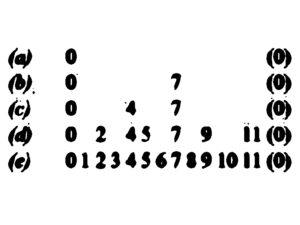
According to Lerdahl, each scale has a graded tone space, which is formed at the highest level by the octaves and at the next finer level by the octave-fifth framework. The triad level with the root, third, and fifth fits into this, into which the diatonic scale is then fitted. The finest structure is ultimately the chromatic scale. For the C major scale, for example, the levels look like this:
| Level a: | c | |||||||||||
| Level b: | c | g | ||||||||||
| Level c: | c | e | g | |||||||||
| Level d: | c | d | e | f | g | a | h | |||||
| Level e: | c | cis | d | dis | e | f | fis | g | gis | a | ais | h |
Lerdahl defines three key figures for this. Two of these relate to shifts in the circle of fifths. First, the number of shifts in the circle of fifths required to map one triad onto another is counted. For example, to map the C major triad onto the D minor triad, two steps are required: a fifth step from C to G and one from G to D. This key figure is denoted by «j.» The second key figure is determined at the level of the scale relationships. Here, you count how many steps you have to take in the circle of fifths to map the scale underlying one chord onto the scale underlying the other. This index is denoted by «i.» It corresponds to the number of sharps or flats that distinguish the two keys. For example, i is equal to 2 for the step from the C major triad to the D major triad, equal to 4 for the step from C major to E major, and equal to 4 for the step from B flat major to D major (2 flats, 2 sharps).
The third index deviates slightly from conventional theory. To determine it, we shift all levels from top to bottom to the triad level c according to two triads to be compared. The D minor triad looks something like this in the C major space:
| Ebene a: | c | d | ||||||||||
| Ebene b: | c | d | a | |||||||||
| Ebene c: | c | d | f | a | ||||||||
| Ebene d: | c | d | e | f | g | a | h | |||||
| Ebene e: | c | cis | d | dis | e | f | fis | g | gis | a | ais | h |
Now count all entries from the upper level that are newly added from one base space to another (ignore those that are omitted). The following are added from the C major triad to the D minor triad:
On level a: one d
On level b: one d and one a
On level c: one d, one f, and one a.
This means that a total of six new entries have been added. This indicator of the different pitches is denoted by «k.»
Lerdahl defines the (local) tension between two consecutive chords as the sum of the three indices. As an example of the tension relationships, he gives a simplified analysis of a Mozart sonata movement:
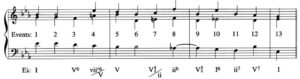
Lerdahl analysis of a Mozart sonata movement
From the first step to the second, the sequential tension = 0, since the same chord is present. From the second to the third (first step to the sixth chord of the fifth step), i = 0 (the scale is the same), j = 1 (the chord is one step away in the circle of fifths) and k = 4 (4 pitches are added according to the specified counting method), so the sequential tension is 5. The measurement series for the tension sequence is:
| I | I | V6 | vii06/V | V | V | V4/ii | ii6 | V4 | I6 | ii7 | V7 | I |
| 0 | 0 | 5 | 8 | 5 | 0 | 11 | 5 | 7 | 5 | 8 | 5 | 5 |
It is important to keep in mind that this «measurement» of tension is not based on the root note, but rather on the step from one note to the next. The step from V6 to vii06/V therefore means a greater tension ratio than that from vii06/V to V.
So much for sequential tension. Determining hierarchical tension is somewhat more complicated because prolongation reduction comes into play.
As a reminder, prolongations reflect the simplification or coarsening of musical structures based on the observation that some events are more fundamental than others. For example, the closing formula:
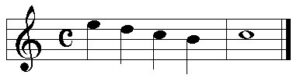 be simplified to
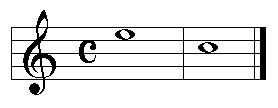
In this example, not only are the notes E, D, C, B, and C sequentially related to each other, but E and C are also directly related to each other at a higher level. In GTTM, as we already know, this is illustrated with the help of a tree structure:
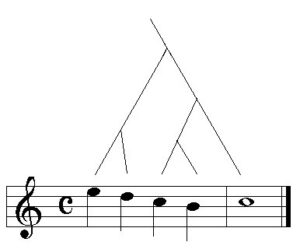
Hierarchical analysis of the closing formula
Here, d is in a certain tension with the higher-level c, and Lerdahl calls this tension the hierarchical tension in TPS.
The basic idea behind determining a measure for hierarchical tension is as follows: it is first divided into a local and a global component. The local component is basically determined in the same way as sequential tension, except that instead of sequentially following events, an event is compared with its direct hierarchical superior. The global component is obtained by adding the tension ratio in which the higher-level event stands to an event that is in turn higher than it. If there are even higher levels of hierarchy, these values can be determined recursively. Lerdahl calls this global component the tension inherited from the dominant event.
All this sounds like pretty heavy stuff. But it doesn’t stop there, because when you take a closer look at the subtle tensions and hierarchies in music, you realize that there are a wealth of subtle forces at play which, to quote Hermann Hesse, together result in a kind of glass bead game. The tension ratios quantified so far only concern the forces that arise due to the positions of events within the «force field» of the scale and chord degrees. Added to this is the melodic energy repeatedly invoked by Ernst Kurth, among others, and the attraction of melodic events by others.
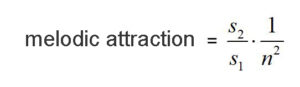
In this respect, Lerdahl explicitly draws on classical physics. He believes that there is a melodic counterpart to Newton’s gravitational force. The formula for melodic gravitation also takes the form of an inverse square relationship. Put simply, the attraction between two melodic events decreases proportionally—in a square relationship to the distance between them. The stability of the two events within the base space also plays a role in the formula given. The resulting formula actually has the flair of a virtual law of physics:
Let s1 be the stability of pitch p1 and s2 that of pitch p2, to which p1 is attracted. Let n be the number of semitone intervals between p1 and p2 (to avoid division by 0, it is also required that p1 and p2 are not equal). The melodic attraction then follows this formula:
An example: The value of s for C is 4, that for f is 2, and there are 5 semitone steps between C and f. The melodic attraction between C and f is therefore:
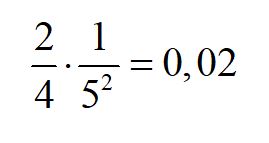
Lerdahl believes that the formula yields plausible results. However, he admits that it needs to be tested experimentally and modified if necessary if it does not correspond to human perception. Incidentally, it is noticeable that the melodic attraction is asymmetrical. The determined attraction of C by f (0.02) does not coincide with that of f by C:

Intuitively speaking, the root note attracts the note on the fourth degree more than vice versa, because the root note has more «mass» in the form of stability within the base space.
Tension and attraction can also be combined, for example by taking voice leading principles into account when determining the tension between chords (in fact, Lerdahl does this in the refined form of his definition of tension). However, Lerdahl believes that «gravitational forces» only come into play in a very limited local area and become mere fiction at greater distances. At greater distances, he believes that memories of global structural properties are more likely to generate tension.
However, Lerdahl is also skeptical about the gravitational metaphor. One reason he sees for abandoning it is the fact that spatial comparisons are universal in relation to music, but the directions seen in that space are not. In other words: even if everyone agrees that music takes place in some kind of space, there is by no means any consensus on what should be considered up and down, front and back, or right and left within that space. Lerdahl concludes that the «remarkable expressive power of music is a manifestation of internalized knowledge about objects, forces, and movements—reflected in the medium of pitches and rhythms.»