
Music is probably the first abstract structure that humanity has encountered in the course of its history. It is therefore not unreasonable to assume that the step into abstract and general thinking originated from the experience of music. And indeed, the first philosophical discussions in human history are presented in close connection with musical experience.
The best known today is the philosophy of the Pythagorean secret society. Pythagoras had postulated – based on older traditions that he had probably learned in Egypt – that the fundamental principle of the world was numbers, or, to put it more simply, that ultimately everything was a number. Pythagoras or his predecessors came to this conclusion by observing physical phenomena in music. He noticed that the tones of a scale perceived as natural were closely related to simple numerical ratios. For example, if a string on a stringed instrument was halved, it produced an octave with the unhalved string; if a finger was placed on the string at exactly a ratio of two to one, a fifth was produced, and so on. There was nothing comparable in the realm of sensory experience and the outside world that achieved such a high degree of accuracy and simplicity. Together with the fact that music is capable of deeply moving the mind, the evidence seemed overwhelming that music must be something fundamental, a phenomenon that apparently reflected the innermost structure of the world.
In order to understand the fundamental significance of music in the development of abstract thought, we must now become aware of the fundamental steps of thought that could be taken beyond mundane everyday life thanks to musical speculation. The first is what the magical human being calls the law of analogy, the second is the number-theoretical potential inherent in the musical overtone series.
The law of analogy is one of the most fundamental principles in mysticism and, in a modern form, also in contemporary science—even if scientists who prefer to distance themselves from mystics generally do not like to hear this. The law of analogy states in a special form that the macrocosm—the world in its cosmic dimensions—is the mirror of the microcosm. It stands at the beginning of scientific thought, is the first important step into abstraction, and is, so to speak, the ladder on which thought has been able to climb to its present heights. The mystical derivation “The laws of the macrocosm correspond to the laws of the microcosm” is one of the earliest attempts at abstract thinking and, as we shall see, has brought the scientific method forward in leaps and bounds, even though, or perhaps because, it failed in its earliest form.
Why is analogical thinking so important? For one simple reason: it allows us to make statements about structures that may be inaccessible or little researched if we can prove that they behave in the same way as structures that are already known. An example of such a correspondence is the biological rule that the individual development of a biological organism is a mirror of evolutionary development. There are even more concrete examples, such as the fact that mercury expands in proportion to temperature. To know how cold it is outside in the morning, we don’t have to go out onto the balcony ourselves. A glance through the window at the outdoor thermometer is enough to reliably determine the temperature from the position of the mercury column.
However, what looks like an analogy is not necessarily one. Many phenomena are not uniform. For example, someone may drive behind us on the highway for a long time, leading us to conclude that they want to go to the same place as us because they are obviously taking the exact same route. However, the conclusion that they will compete with us for a parking space at our destination is obviously incorrect. After two hours of persistent tailgating, the red convertible has suddenly disappeared.
Our lives are full of (justified and unjustified) analogies. We couldn’t live without them. For example, we conclude from the fact that the sun has risen every day so far that it will rise again tomorrow – and we have a very well-established framework theory to back this up. This wasn’t always the case. The sun worship of ancient cultures is usually linked to the fear that the sun might one day refuse to rise. After a few weeks of the same ordering ritual, the waiter at our local bar brings us what we always want without asking (and actually, today we would prefer tea instead of coffee, but we don’t dare say so for fear of offending the nice man). We orient ourselves using street maps, whose structure is obviously analogous to that of the landscape outside.
However, we can only really rely on an analogy if we have a conclusive explanation of why it exists. This means that we must be made to understand that the analogous behaviors cannot be any different than they are because the analogous phenomena also obey analogous laws. As a rule, we fall back on a proven framework theory—in the case of mercury, for example, thermodynamics. The law of analogy in its mystical form fails to meet this requirement. Even simple claims of analogy are regularly refuted by experience (the predictions based on them prove to be false, or they are so vague that they apply to anything and everything), and it is also impossible to provide a coherent framework theory or explanation for the claimed mystical analogies.
The law of analogy is most strictly formulated in mathematics – and that is also where it has found its most beautiful expressions. Proving an analogy between seemingly distant structures is something like Christmas, Easter, and getting married all rolled into one for mathematicians. Modal logic, for example, has shown that the analysis of the concepts of necessity and possibility is analogous to that of ethical obligation and permission, and one of the most famous theorems of modern times, Gödel’s incompleteness theorem, has been proven twice in analogous but different structures: by Kurt Gödel using set theory considerations and by Alan Turing in the form of a most general model of a computing machine. A mathematician friend of mine explains how even simple proofs can be made in his field with the help of such analogies. For example, the number of ordered subsets of a set can be determined by showing that it behaves exactly like counting in the binary system.
In the case of a mathematical «analogy,» mathematicians speak of a so-called bijection between two sets, a mapping that assigns exactly one element of set B to each element of set A (and vice versa):
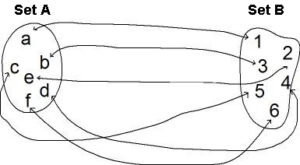
each element of one set is assigned exactly one
element of the other set, and this in both directions.
However, a bijection is not enough, because it does not yet include the framework theory. There is therefore a mathematical structure – called isomorphism – that also takes into account the relationships between the elements. If the mathematician knows that there is an isomorphism between two structures, then he can be sure that manipulations of one set will have analogous effects on the other.
In the bijection given above, each element of set A is uniquely assigned to an element of set B (in mathematical jargon, «uniquely» means that the assignment applies in both directions). In the example, the natural order relations of being greater than and following each other in the alphabet are not correctly represented: a is assigned 1, but b is assigned 3 and c is assigned 5. So if we say in set A that a and b immediately follow each other, we cannot follow the arrows emanating from a and b and then say that 1 and 3 immediately follow each other.