
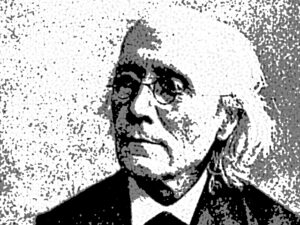
Fechner’s psychophysics
Fechner’s (1801 – 1887) life and work are typical of 19th century science and seem outwardly unspectacular. Although, as mentioned, he was born in what is now Poland, Fechner hardly ever left the walls of Leipzig, an intellectually extremely lively community that even awarded him honorary citizenship at the age of 83. This external calm enabled Fechner to produce an extensive body of physical, psychological, philosophical and – under the pseudonym Dr. Mises – even satirical work. He was only disturbed by an eye condition, which forced him to give up a professorship in physics at the age of 38 and concentrate on philosophy.
Otherwise, his life was as pleasantly unspectacular as it could be: he studied medicine at the University of Leipzig, published an encyclopaedia for the Breitkopf & Härtel publishing house, married the daughter of a Leipzig alderman at the age of 32 and co-founded the Royal Saxon Society of Sciences. After 1850, he did not move again until his death. He lived in the front house of the corner property at Blumengasse 2/Dresdner Straße 15. A memorial plaque commemorates the prominent resident.
In the second volume of his main work «Elements of Psychophysics», Fechner passes on the credit for laying the foundations for the scientific theory of the mind-body problem to his mentor Ernst Heinrich Weber (1795 – 1878). In fact, Weber enriched the discussion on the relationship between body and soul with an experimental approach. With numerous experiments on touch and other senses, he established that «the size of the increase in stimulus must grow in proportion to the size of the stimulus that has already grown in order to achieve the same for the growth of sensation». Fechner quantifies Weber’s approach and thus lays the foundations for a precise understanding of the relationship between the physical world and its effects on the mental world.
Fechner establishes that the increase in intensity of a sensation is not linear to the increase in the associated stimulus. The stronger a stimulus is, the more it needs to provoke the sensation of an increase. The quantification is closely related to the so-called perception threshold, below which a person does not perceive any stimulus or any change in stimulus.
An example will literally shed light on Fechner’s discovery: Let us assume that ten candles are burning in a room and that two additional candles are needed for people to be able to perceive a difference in brightness. If twenty candles are burning, it takes not just two more candles to make a difference in brightness just perceptible, but four. In the case of 30 burning candles, six more are needed and so on. This means that the perception of greater intensity increases less than the increase in the stimulus.
Weber gives the relationship in mathematical form:
If b is the magnitude of a stimulus in the physical world and g is the magnitude of the sensation that the stimulus triggers in mental experience, then the sensation changes depending on the change in the stimulus according to the following formula: 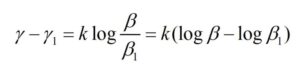 This means that the increase in sensation increases in a logarithmic relationship to the increase in stimulus. The law is still often mentioned today, often with the somewhat patronizing remark that it is only valid within certain limits. However, anyone who reads Fechner’s original texts can easily see that the Leipzig scientist was well aware of the limits of the formula. Fechner’s achievement does not lie in the formulation of the actual mathematical facts, but in the perspectives he opened up for experimental research and quantification of the relationship between stimulus and sensation. Since then, hardly any significant progress has been made in closing the gap between the two worlds.
But it’s like the joke about the man who wears glasses and is delighted with his new glasses – not because they make the strange blurry ghost spots he always sees disappear, but because he can see them much more clearly with the glasses: the problem has not been solved since Fechner’s work, but it can be grasped and isolated much more precisely.
One remembers that such a relationship had already been formulated once before Fechner in the history of musical aesthetics in a somewhat different field, namely (as Fechner himself mentions in the «Elements») by Leonhard Euler: the perceived pitch is in a logarithmic relationship to the physical frequency.